
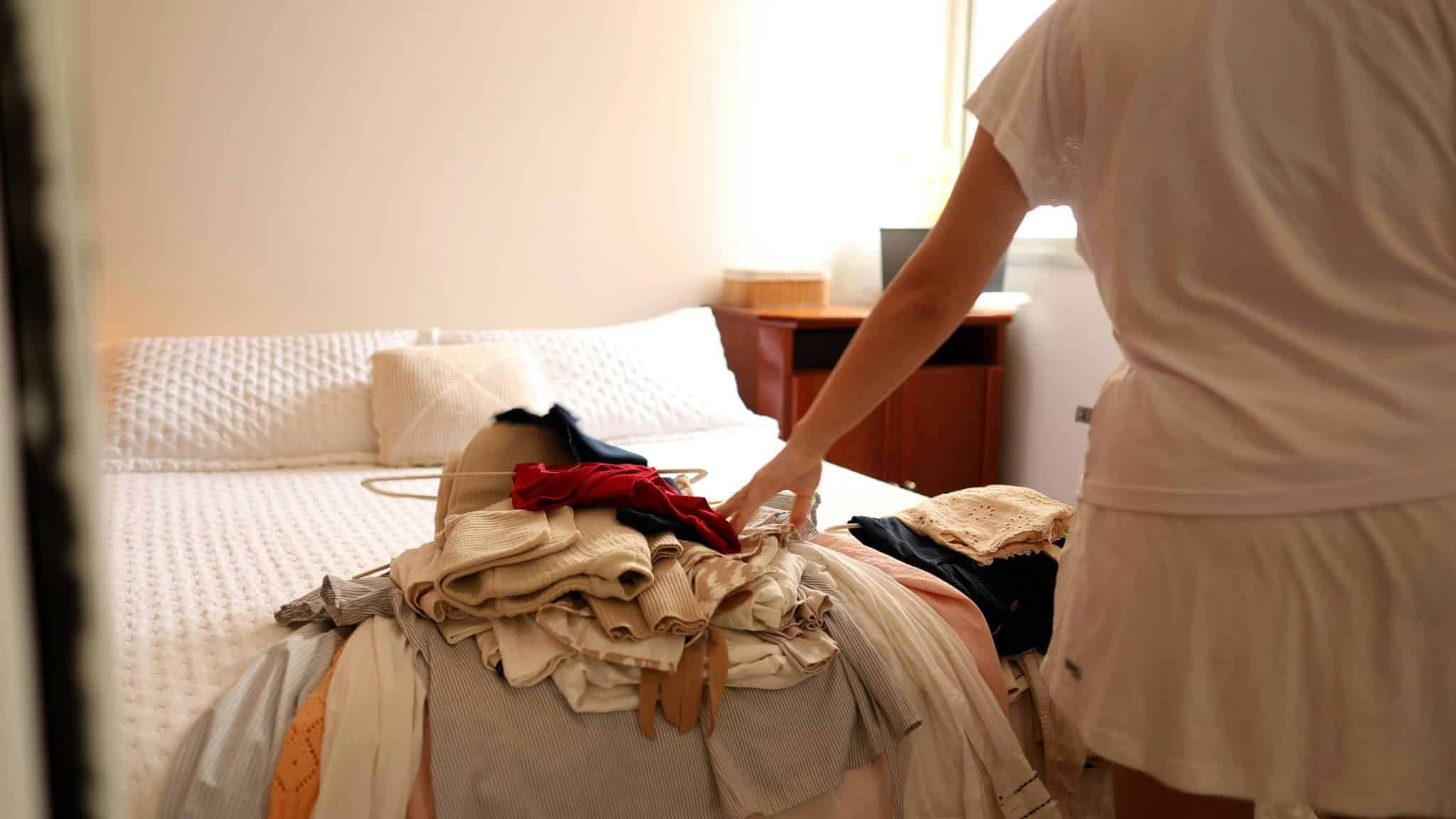
We already talked about five hard truths about decluttering. Now I want to go over five hidden benefits of decluttering that you might not be expecting.
Five Unexpected Decluttering Benefits

1. Headspace
The weight that is lifted from us in a clutter-free environment is hard to understand if you’ve never experienced it.
When the living space is cluttered, our brain is overworked. We keep an ongoing mental list of undone tasks, plus we have to process extra visual stimuli–this quickly leads to overstimulation, lower cognitive function, and emotional agitation.
Before decluttering my home, I remember feeling so STUCK. I’d walk into a room and forget why I was there. I’d get sidetracked tidying something or just digging through a random pile. Maybe I had started looking for something, then found something else, the initial task quickly forgotten and abandoned.
Now I move through my home with confidence. It’s easier to stay on task, there are fewer things to process, and I don’t feel so overwhelmed just moving through my house.
2. Social freedom
Picture this: You put a pot of coffee going in the morning, then pop outside to check on the garden while it brews.
Your neighbor walks up to you. They’re relatively new to the area and you don’t know them very well yet, but they always greet you with a friendly smile and wave, and their gardenias are gorgeous–you’ve been dying to pick their brain about how they fertilize.
Wouldn’t it be nice to invite them in for a fresh cup of coffee?
But then you flash back to the stacks of junk mail on your table. Your cluttered counters. The million little undone tasks all over the house. You’re flushed with anticipatory embarrassment, and instead of inviting them in, you smile politely and tell them to have a nice day.
But what if your home was clutter-free and you didn’t feel so embarrassed to have people inside?
Social situations become easier with a decluttered home and what matters can take the front seat–connection. And getting those fertilizer tips.
3. Self-discovery
I have a memory box where I keep notes, letters, ticket stubs, little trinkets, souvenirs… It’s a small box, and I don’t look in it often. But once a year or so, I’ll pull it out and read through a few things.
Letters from friends, notes from exes.
Last week, I pulled that box down and sat with a bottle of wine on my living room floor. I read through everything. I cried a little. It was a good grounding exercise, and while I’m anti-clutter, I will ALWAYS support a memory box.
One of the reasons I got so emotional was that those letters and notes described a person I no longer saw in the mirror. Honestly, I’d kind of forgotten she even existed.
In particular, there was something an ex wrote… “I love how you fight. The way you make eye contact, challenging. Strong.”
Somewhere in the years between then and now, I lost a lot of my fight.
That’s somewhat a good thing. I was probably too combative a lot of the time.
I’d rather move through the world with peace, but in remembering that past Mia, I realized I may have over-corrected. She had rough edges, but she was strong and effective and she fought for those unable to fight for themselves.
Those are traits I still value and would like to foster again.
One simple line written by someone I haven’t spoken to in years was enough to shake my self-identity and remind me of the person I was not so long ago. She’s still in there, if I need her. There was a comfort to that, and also a clarity.
Our belongings carry memories of who we were and what we wanted before.
It all came back as I read through those letters. I remembered the good things about past Mia, and the bad things.
Things that I’m proud of myself for growing from and moving past.
And ways of being that I valued and may have lost along the way.
Going through our clutter can be such a tangible reminder of the way things used to be, giving us clarity on who we are now. We can see our progress and better understand where to go next.
4. Confidence
Many people find themselves emotionally paralyzed at the beginning of their decluttering journey. They second-guess their choices, doubt their ability to make the right decision.
I worked with a client last year–let’s call her Cathy–who struggled with paper clutter, specifically on her dining room table.
She kept everything. Receipts, old to-do lists, Christmas cards, even junk mail.
Nothing in that pile was useful. She’d already filed or taken care of the things that were important. Now a lack of confidence held her back and held her dining room table hostage.
I sorted through the mountain of papers with her, collecting everything that looked like phishing and scams.
“Cathy,” I told her gently with a thick pile of envelopes in my hands. “These are scam letters…why do you feel like you need to keep them?”
She didn’t have an answer.
So we shredded everything I’d collected.
The next week, I came back to her house.
“Did you miss any of those papers?” I asked.
“Obviously not,” Cathy said sheepishly.
That day, we sorted a pile of save-the-dates for events that had already passed. I made another pile of coupons that had expired. She didn’t even hesitate to say “yes!” when I asked if I could get rid of both.
That same afternoon, I got a text from Cathy: Mia, I shredded it all.
She’d attached a selfie of her grinning, the cleared dining table shining behind her.
Taking those baby steps broke the dam for her. She saw that there were no negative consequences. She felt freer not having all of those papers weighing her down, so she confidently tossed the rest of it.
Decluttering starts slowly, then you build confidence and momentum and it becomes effortless.
Powering through the process can truly revamp your confidence in yourself and change the way you move through the world.
5. Financial awareness
Decluttering forces us to confront our spending habits. It reveals what we put our money toward and forces us to ask why.
Did that purchase actually improve our lives, or did it simply add to the clutter?
Decluttering is an examination and reflection of your current lifestyle. If you’re going through your things saying, “Why on earth do I have this?” or, “What was I thinking??” that’s data. That can show you where your behavior and ideals are not aligned.
If you own three bread makers and haven’t made bread at all this year? Maybe not even last year? Those purchases were likely not informed decisions. You can declutter at LEAST two of those bread makers and know never to buy another.
Realizations like that can be hard to swallow, because you’re probably not going to get any of that money back. Reselling is tough and often won’t even make you back half of what you spent. The best way to handle it is to learn the lesson and move forward knowing better.
Want some guidance to get started?
Are you ready to put this into motion? Here are 100 easy items you can declutter today. It’s organized by room and great for printing or digital use.
Download it for free:

What is an unexpected benefit you’ve found in your decluttering journey? Tell me about it in a comment!
