
Let me guess–you love the idea of an affordable, sustainable, healthy, and ethical lifestyle, but it’s so hard! There are so many options, so much thinking, and seemingly so much effort to make the “right” choices…and it can be so hard to even know what the right choice is to begin with.
Today we’re talking about real strategies and practical swaps you can make in your bathroom–here’s how to take one step at a time toward that sustainable, healthier lifestyle.
First we’ll go over general standards, then we’ll look at specific products and swaps in the following bathroom categories:
- Razors and shaving cream
- Shampoo and conditioner
- Hand soap
- Body wash
- Brushes and loofahs
- Moisturizer
- Skincare
- Makeup remover
- Hairbrushes
- Toothbrush and toothpaste
- Floss
- Menstrual products
- Toilet paper
- Deodorant
- Q-tips
- Bathroom cleaners
Sustainable beauty and hygiene routine standards
Before we get into the list of swaps, let’s go over a few of the general concepts to keep in mind when creating a sustainable bathroom routine.
Less is more
The simpler your routine and the fewer products you use, the more money you’ll save, the more sustainable it is for the planet, and often–the healthier you’ll be.
You may notice that the more you try to “doctor” your skin, the worse it gets, for example. Often, the simplest routines are the most effective.
Don’t pay for water
You’ll see a “water up-charge” in most products. Basically, they’re 80% water, so you’re paying for a diluted product, plus the price is inflated for packaging and shipping. And those products often have to be contained in plastic, since they’re liquid.
If you buy the undiluted version–for example, bar soap instead of liquid body wash–you’ll save a ton of money and waste.
Use what you have
Don’t toss your perfectly good products to swap for more sustainable options. Instead, prepare to make an informed switch when you run out or your current tools stop working.
The most ethical, sustainable, and affordable option is always going to be using up what you already have.
Take it one step at a time
Swapping your whole bathroom at once is overwhelming and might scare you off from making meaningful change. Instead, focus on one product at a time until you find what works, then you can move on to the next.
Sustainable bathroom swaps
Okay, here’s the list.
Razors & shaving cream
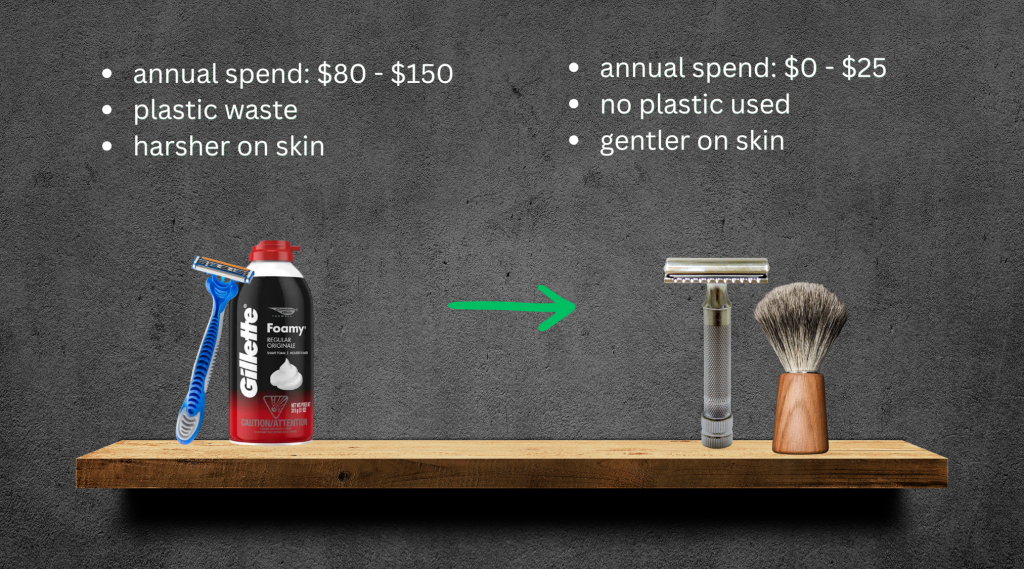
If you shave, you might be using plastic handles with plastic cartridges in plastic containers that you have to replace every few uses, and maybe those bulky cans of cream that only last a couple of weeks.
Let me tell you: For the last two years or so, I have spent $0 on hair removal products and accessories. Here’s how.
Safety razors.
This Zero Waste Safety Razor from EarthHero will last you actually forever and is a comparable price to plastic versions from low-value retailers like Walmart.
Then you can get 15 replacement blades for half the price of FIVE plastic blades.
Shaving sticks and brushes.
For shaving cream, I bought a two-pack of shaving sticks (you rub it on wet skin like soap, then use a shaving brush to lather) YEARS ago, and I still haven’t run out. I bought both for $5, and I’m still on the first stick.
For an ethical, ecological, affordable swap, here’s the full kit:
- Safety razor
- Replacement blades
- Moisturizing shave bar
- Lather brush (you probably already own a skin or makeup brush that will work just fine)
If you want to be hardcore, consider if you even need to remove the hair at all. 🤔 It’s perfectly acceptable to let your body be however it naturally wants to be. That’s not a lifestyle everyone is comfortable with, but it’s certainly something to consider.
Shampoo & conditioner
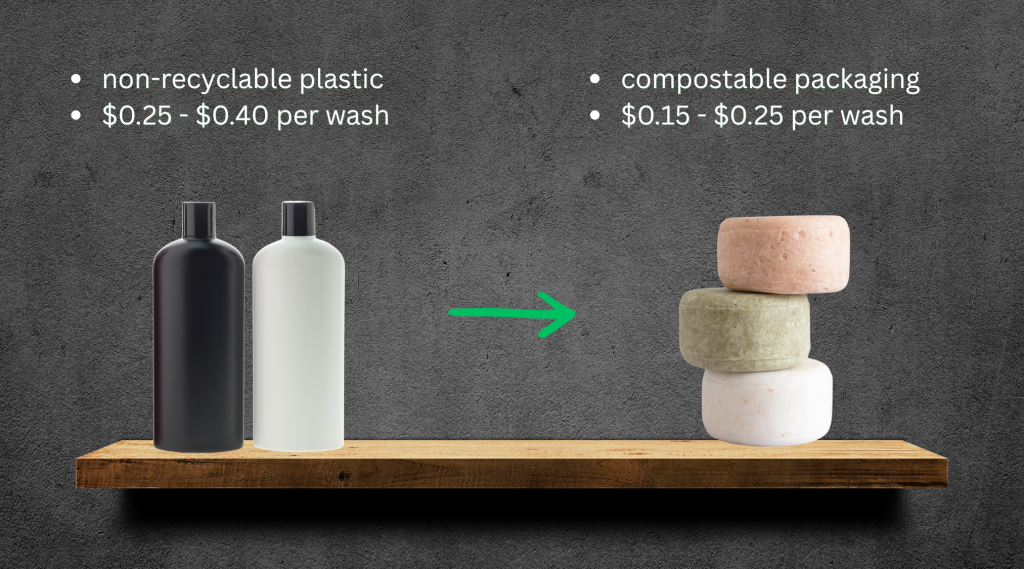
A “scam” in bathroom products is that many of them are 80% water. That makes it more expensive to store and ship–a cost passed onto the consumer.
Bar products aren’t watered down, making them more affordable.
Most people who hesitate to swap to the shampoo bar are often worried about the lather–and it’s true that many shampoo bars miss the mark here. But I’ve done a lot of experimentation, and here’s what I’ll say on the lather:
- If you’re not double-shampooing, you’re not getting a good enough lather with your liquid shampoo either. Start there.
- Try a lather bag like this one.
- Choose the right shampoo bar. I recommend Sun Basin.
Sun Basin products are made with all-natural ingredients, minimal and compostable packaging, plus 100% of profits go to the Maternal Center of Excellence in Sierra Leone.
Check ’em out: Sun Basin shampoo bars.
Use code NOURISHINGMINIMALISM for 10% off your first order.
While the initial cost of a bar may be higher than a bottle of liquid shampoo, you’ll typically pay less for it per use because it lasts so much longer.
There are conditioner bars as well, but as I haven’t found one that works well for my hair, I won’t make a particular recommendation. I have curly hair that runs dry and is pretty delicate, but if you have lower-needs hair, you could try out a few conditioner bars and see if they work!
Hand soap
Bar soap works for your hands, too, but some people really prefer liquid here. If that’s you, I recommend hand soap tablets.
EcoGeek hand soap tablets are easy to use–just drop one in a reusable foaming soap dispenser with warm water and give it a shake.
The soap is non-toxic and 100% of profits go to the Coral Reef Alliance: EcoGeek Foaming Hand Soap.
Use code NOURISHINGMINIMALISM for 10% off your first order.
Body wash
Bar soap of any kind is going to be more sustainable, affordable, and last longer, for the same reasons we went over for shampoo bars. My personal recommendation is the bar soap from Sun Basin, but any bar soap should be better than liquid.
Brushes and loofahs
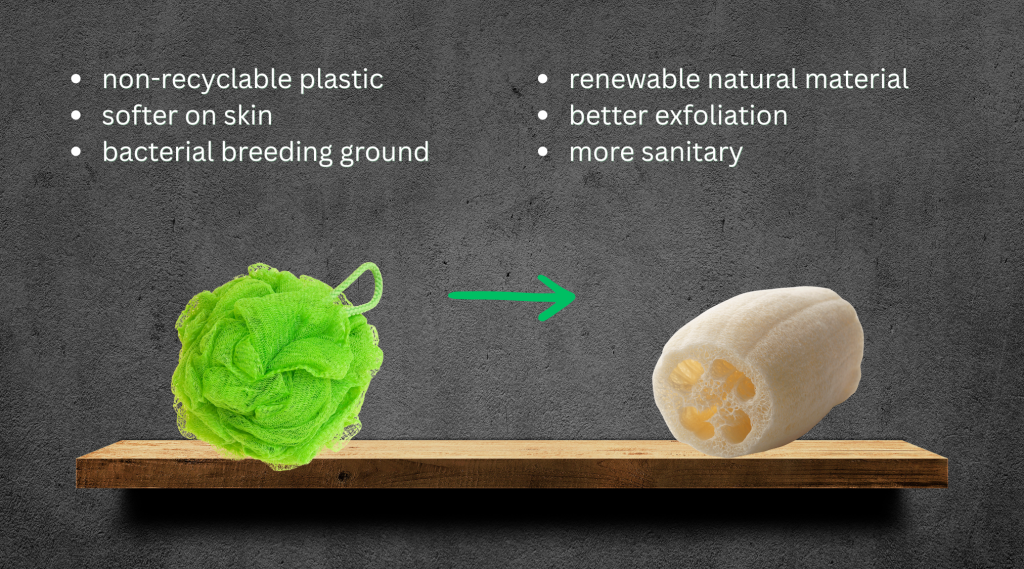
Natural sponges and real loofahs are great plastic-free options, like this one. If you’re a gardener, you can even grow your own luffa gourd! It’s a fun project, and you only need to buy seeds once–then you can harvest seeds to plant again next year. They’re compostable, effective, and make fabulous additions to gift baskets.
Moisturizer
For hands and feet, this all-natural lotion bar is a great option. I say hands and feet because I personally have sensitive skin, and rubbing it along any other part of my body can be irritating.
Another option is to go raw. Use ingredients like jojoba oil, aloe vera, coconut oil, or shea butter–mixed together or on their own. Buying one (or more) of these simple ingredients is pretty affordable, uses minimal packaging, and you can be sure about what you’re putting on your body.
I love to use jojoba oil after a shower, then shea butter as needed for extra moisturizer.
Skincare
The most sustainable change most people can make to their skincare routine is to simplify.
All you usually need is a gentle cleanser, moisturizer, and SPF. Once you find a product that works for you, stop experimenting. Overconsumption in this area is rampant. There’s no need to keep shopping for products once you find what works.
After you’ve simplified, you can look for raw/whole ingredients to use.
For example, I keep a few aloe vera plants and use the gel for a sustainable, all-natural facial treatment. I simply shave the skin from the leaves, hit them with an immersion blender, then keep it in a jar in my fridge. After I wash my face at night, I’ll put on a layer and go to bed with it on.
I won’t link to any specific products here since skin needs are so unique to the individual, but the general guidelines to follow:
- Simplify
- Stop shopping after you find what works
- Default to whole ingredients you can buy in bulk
Makeup remover
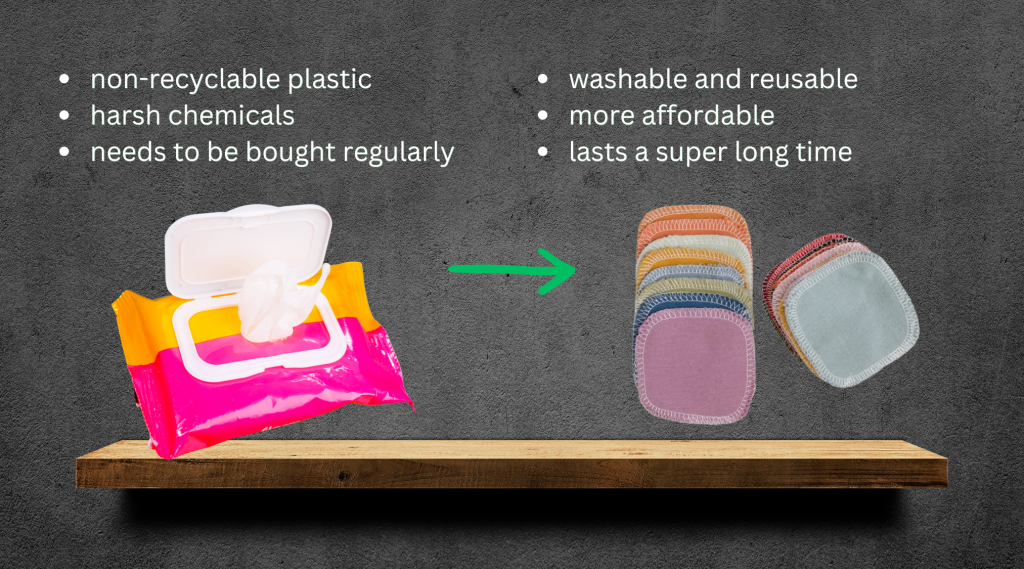
You can swap your disposable makeup remover wipes for reusable wipes–but really, you could make your own with an old T-shirt for free.
Jojoba oil is my go-to for a ton of things, including makeup remover! Some people use coconut oil, but I find jojoba doesn’t leave my skin feeling greasy.
Hairbrushes
When it’s time to replace your hair brush, the most sustainable option is going to be non-plastic–unless you’re okay thrifting a plastic brush and sanitizing it.
If thrifting a hair brush squigs you out, I get that! I don’t think I’d do it either, unless it was obviously brand new. In that case, try something like this bamboo hair brush from EarthHero.
But as always, the most affordable and sustainable option is to use what you already have until you need to replace it.
Toothbrush & toothpaste
The classic sustainable option for toothbrushes is bamboo brushes over plastic. There are even bamboo replacement heads for some electric toothbrushes, like this Sonicare option.
When I buy toothbrushes, I go bamboo. But I’ll be honest–I grab that free plastic one from the dentist every time I have a cleaning. 🤷♀️
The most sustainable toothpaste on the market is tablets–you simply chew it, then brush as usual. Tablets remove the water waste and come in compostable or reusable packaging.
Unpaste is a popular brand–it costs about $6 for a month’s supply.
Kaylaan is another popular option with a trial pack option to try the different flavors.
Some people hate the taste, texture, or lather of the tablets, but they’re always improving–I give them another try every couple of years, and they have genuinely gotten better. With my sensory issues, I struggle to make the full transition. Have you tried them?

Floss
Instead of chemical-covered plastic string in a plastic container, you can opt for bamboo floss (optionally covered in natural charcoal for tooth whitening). The floss is compostable, it arrives in a compostable box, and it can be stored in this adorable and convenient glass container that lasts forever.
Subscribe and save at the link above: 66 yards of bamboo floss for $11.19. If you’re flossing once a day, that’ll last easily over four months.

Menstrual products
If you’re using disposable tampons and pads, there are tons of alternatives to look into.
Menstrual cups or discs can replace tampons–just be sure to sanitize and store them properly. When used as instructed, these are MUCH healthier options without the risk of toxic shock syndrome.
Period underwear design is always improving. I remember the first pair I bought 15 or so years ago basically felt like wearing a diaper. 😅 But the newest pairs I have from Saalt just feel like regular underwear! I highly recommend trying them if you haven’t yet.
Reusable pads and pantyliners also exist. I’ve even made my own out of an old flannel shirt, a towel, and snap buttons to secure the wings together.
These options might be more expensive upfront than a box of tampons–especially if you go the period underwear route–but they pay for themselves in the space of TWO cycles. The annual spend on reusable items is roughly the same as monthly spend on disposable menstrual products.
Definitely worth the upgrade.

Toilet paper
There are brands of toilet paper made from bamboo and other more sustainable materials, but they tend to run a bit expensive–like these rolls from EcoGeek for around $2 each.
An easier swap you can make that pays for itself is to install a bidet.
Some people forgo toilet paper altogether after they buy a bidet–instead, they dry themselves with a built-in dryer on the bidet, reusable rags, or even rocks. Yep, rocks…
Personally, I use my bidet and toilet paper. I use a lot less toilet paper because of the bidet, and I come out overall cleaner.
Deodorant
Deodorant is a tough category. People usually fall in one of two camps–pro-aluminum and anti-aluminum.
Anti-aluminum people say it clogs pores, is “toxic,” and causes cancer and/or Alzheimer’s. Available research doesn’t support those claims–but some people feel better allowing their bodies to sweat naturally.
On the other side of the debate, pro-aluminum people think anti-aluminum people are STINKY!!! Sometimes because…they…are. 😬
BUT, the choice is yours, obviously.
Beyond the aluminum/natural deodorant debate, we can consider packaging (most deodorant comes in plastic containers).
You can buy options in cardboard containers, but they usually run around 2x to 3x the price of a plastic container.
Some people opt for spraying rubbing alcohol or vodka onto their pits, eating clean, and–to some extent–embracing their natural smells.
In fact, Rachel wrote a couple of blog posts about her homemade deodorant and DIY deodorant spray you can check out for more natural options.
Q-tips
Q-tips are tiny plastic tools that many of us can simply do without.
But if you have a need for them, there are cotton and bamboo options, like these: Cotton Swabs.
Or silicone options that you can clean and reuse like these: Reusable Silicone and Bamboo Swabs.
Bathroom cleaners
I like to use basic ingredients for most of my cleaner purposes–rubbing alcohol, baking soda, vinegar, and a melamine sponge usually get the job done in my house.
But if you feel better using a “real” product, here are a few great options from EcoGeek–remember, they donate 100% of profits to the Coral Reef Alliance, they’re non-toxic, and they use no-water, low-waste production:
For the tablets, just drop it into your reusable glass spray bottle and add water!

Living more sustainably doesn’t have to be expensive, and it doesn’t have to happen all at once. The simplest way I’ve found to do it is to keep an eye on products you’re running low on, then spend the time between now and running out of it to find a better option. It doesn’t have to be the BEST option–just better than the previous purchase was.
Make incremental improvements for real lasting progress. And ALWAYS use up what you already have before you buy something new. 🙂 You’ve got this.
If you have questions, ideas, or product recommendations you’d like me to add to this post, please leave me a comment below!
Ethical Shopping Guide
Looking for more categories to expand your sustainable efforts? I wrote a shopping guide that includes clothes, groceries, pet supplies, media and entertainment, furniture, and more. Find it here: Ethical Shopping Guide 2026.
