

You’re not crazy, and you’re not lazy. The clutter-depression-anxiety cycle is real.
Clearing your cluttered space can relieve anxiety and depression, but it’s a daunting task, especially if you’re already battling depression.
Here are ways that living in a cluttered environment can negatively impact your mental health and physical well being–and how a more peaceful environment can help you avoid feeling overwhelmed, prioritize self care, be calmer, and improve your mood.
I know it can be overwhelming to even think about a home declutter. But I’m going to give you some steps and resources to manage it and start small.
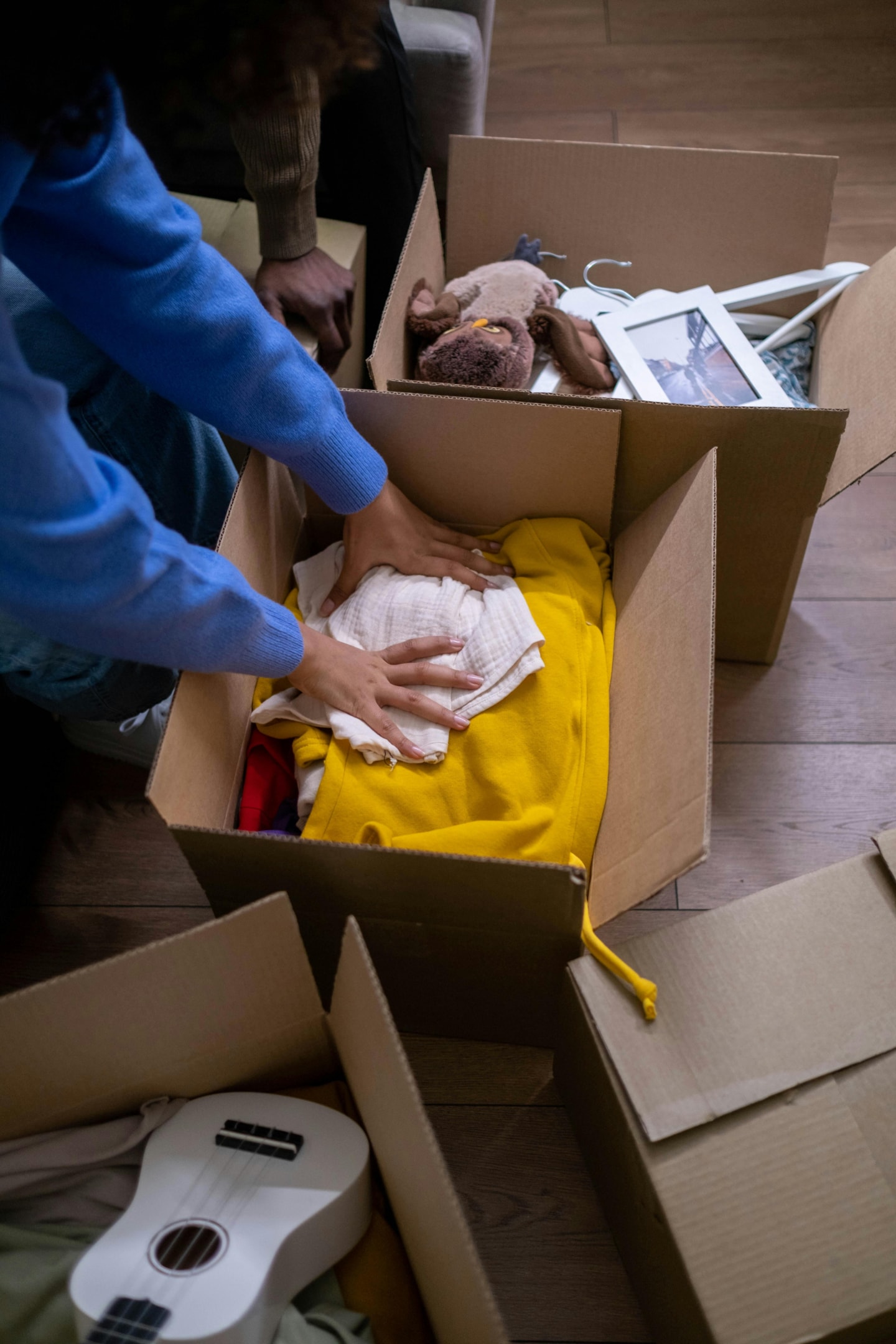
Mental health benefits of decluttering
Decluttering your home leads to a more comfortable living space and better mental health. Here are just a few ways minimalism and decluttering can improve your mental well being.
1. Improved Focus and Productivity
The human visual cortex is the part of your brain that processes visual input. Cluttered spaces affect this processing, leading to information overload, poor focus, increased stress, impaired decision making, and worse memory.
A tidy space is less distracting, allowing for better focus and more efficient use of time. Decluttering helps clear mental space as well as physical space, making it easier to concentrate.
2. Better Sleep
A clean, clutter-free bedroom is more conducive to relaxation, potentially improving the quality of sleep. A well-functioning visual cortex can also contribute to better sleep.
If you aim for better sleep, start your declutter in your bedroom. I recommend only keeping essentials there, if possible, and avoid electronics and screens.
3. Reduced Guilt and Shame
Clutter can often be a source of guilt or shame, especially if the mess feels unmanageable. Decluttering reduces these feelings by creating a more orderly, serene environment.
Clutter > shame > depression > anxiety > not addressing the clutter > more shame > more depression. You get it.
We can break free from that cycle. I know because I did it!
4. Increased Sense of Control
Organizing and decluttering your space gives you a sense of control over your environment, which can alleviate feelings of helplessness or frustration. Maintaining some order in one piece of your life will help you maintain the rest of it.
5. Emotional Release
Letting go of items tied to past experiences can help release emotional attachments and promote healing, offering a fresh emotional start. Sometimes items that aren’t even tied to something negative can still weigh us down emotionally.
Give yourself a clean start and a leg up on getting your mental health in hand.
Does decluttering help with anxiety?
Yes, decluttering helps with anxiety greatly, and in several different ways.
Clutter often leads to feelings of chaos and overwhelm. Decluttering creates a more organized environment, which can reduce stress and promote a sense of calm.
Clutter also causes us to feel guilty and like we’re stuck in one place. Those feelings grow into panic, which can make us MORE stuck.
Decluttering lowers stress levels, helps us process information more effectively, improves our mood, and offers tons of other mental health benefits.
Getting rid of clutter boosts your self-confidence
Decluttering may also help you feel better about yourself because it’s something of an accomplishment, says Dr. Robert London, a psychiatrist based in New York City:
“The clutter leads to anxiety, embarrassment, family stresses – some kind of despair,” London says. “When you relieve the problem and learn to throw things away, you feel better.”
You might also begin to tackle deeper problems that cluttering is covering up, he adds. “You’ll find theories of why people do this. They might have unconscious guilt, so they assuage that guilt by carrying out these rituals.” – USNews
Getting rid of clutter is typically a very emotional process, and that’s okay. Don’t let the thought of confronting your emotions scare you off from improving your life and health.
We have to face those difficulties to move through them, and I know you can do it.
Getting rid of clutter means accepting yourself for who you are
So much of how we live is based on what we want others to think of us.
For some people, this looks like a full calendar and many volunteer activities. They are so busy helping other people, they don’t have time to even think about their own weighty issues.
For others, this looks like a house full of books because they long to escape and live vicariously through a fictional character.
For others, this looks like a houseful of their parent’s belongings, because when their parents passed on, it was easier to take the stuff than to say final goodbyes and find closure.
Most of us don’t want to sit alone and think about us, our life, where we are, and where we want to be. It can be scary to think about!
Feelings of un-belonging, grief, guilt, and shame are difficult things to process, but once you have, you will feel the weight lifting off your shoulders.
And the first step toward that is likely to declutter your physical space. The mental health benefits will come later.
Getting rid of clutter boosts your physical health
A recent study found that performing at least 20 minutes of daily physical activity, including domestic housework, benefited mental health and lowered risks of psychological problems. – Everyday Health
We’ve already covered how much decluttering the bedroom can help improve your sleep, and sleep is essential for EVERY bodily function–mental, physical, emotional, essential, and tertiary. Sleep controls it all.
And with a clean, inviting kitchen, you are more likely to cook at home and make healthier food choices.
You’re more likely to notice how much water you have been drinking and, after sorting through the fridge and pantry, you’re more likely to fill it up with healthy options and limit the packages of snack foods.

How to start decluttering when you’re not motivated
Motivation is fickle–it depends solely on our state of mind. We can’t always rely on clicking into productivity mode.
So if we’re depressed, how on earth are we supposed to get motivated?
You’re not.
You don’t need motivation.
Instead, you can simply take action, disregarding how you feel about it.
I love Mel Robbins’ 5-Second-Rule–you don’t allow yourself to pause and think–if you do, your mind will talk you out of taking action.
As soon as the thought comes into your mind of: “I should declutter the coffee cups.” You start counting down… 5, 4, 3, 2, 1!
And you hurry to the cupboard and pull out the coffee cups.
As soon as dinner is done and you have the little thought of, “I should do the dishes.” You count down: 5, 4, 3, 2, 1! and you walk into the kitchen and do a load of dishes.
Counting down makes your brain stop–it can’t convince you vegging in front of the couch is better, because you are counting down and ready to run.
And once you’re started, there are no more thoughts to have–just do the action.

Don’t let perfectionism prevent your progress
I know how much perfectionism gets in the way. We all have these ideas of how the job should be done and we don’t want to get it wrong.
Like the old saying, “If you can’t do it right the first time…” But I’m telling you:
Done is better than perfect.
Allow yourself to clean the toilet with a baby wipe. Allow yourself to mop without a “proper cleaning solution.” Allow yourself to vacuum without moving the furniture. It doesn’t matter how you do it–it matters that you do it.
This applies to everything, from housework to physical exercise. A quick walk around the block when you don’t have time to hit the gym is better than not getting any movement at all.
Go for consistency and stop worrying about perfection.
Decluttering With Depression: A gentle guide to healing.
You don’t have to go about this alone! Let us help you create a peaceful place that can finally allow you to heal.
Decluttering With Depression is a self-paced guide to help you develop healthy coping strategies, address thought spirals that keep you from making progress, and create an internal and external environment that promote wellness.


This article was spot on Rachel. It is amazing how much happier I am when my house is clean and clutter free. Reading posts like this one makes me even more passionate about trying to live a clutter free life. Thank you!
Rachel, your article is really encouraging and the answer to my awful state of time management & where my position in still a long way of how to train my young kids to behave. Thank you deeply.
Done is better than perfect.
Thank you so much for this. I’ve just discovered your site. I have been suffering through depression, anxiety and I feel like my life is in a rut. I’ve realized that a lot of it is because of the clutter in my house. We moved to our home four years ago. We brought a lot of stuff. My parents are pack rats and I inherited the trait.I had grand plans of organizing and minimizing – I wouldn’t be like my parents, I said. Fast forward to the present. I’ve not gotten rid of the initial clutter and now it has four years of added stuff on top of that. It’s embarassing, to everyone else and to myself. My husband’s been bugging me to ask for help clearing things out, but I always say that only I can do a good job at it so only I will do it. Since a lot of things have gotten in the way, I haven’t actually done anything. I am beating myself up for it, because…why can’t I do it? How come others can have great looking houses and I can’t. I know it’s because I can’t even start so I accomplish nothing. I am proming myself to just *start* – do what I can when I can. And I also promise not to be too hard on myself. Thank you, Rachel!
I also appreciated this article….I deal with depression and anxiety and have just way too much stuff in my house. I’m inspired to make 2019 the “Year of Less” and plan on scaling WAY down in the possessions department. I’m nervous because I am a pack rat also but know that the outcome will be well worth the difficulty of parting ways with my “stuff.” Thanks for your inspiration and words of wisdom
I’m ready to progress forward. Thank you for the encouragement. I’ve gotten discouraged by my clutter. I’m taking steps to de clutter.
This article is encouraging. I am so overwhelmed that I have no clue where to start. I think reading this will me get started even if it is a small task. Thank you.
I am a single woman in my early 30’s, who’s been through a lot of personal trauma, and I have daily chronic pain that sucks the energy right out of me. As a result, anxiety, depression, and exhaustion have created the perfect storm for the pack rat ways I grew up with, to materialize into a vicious cycle. It starts off with positive thoughts and intentions, knowing that I’ll feel better after I clean and declutter my house, and then when I start thinking about where to even begin, I subconsciously start clumping all of the things that need to be cleaned and gotten rid of, into one hugely overwhelming job. Then, I tend to get in my own way by letting my brain tell me how exhausted it will make me feel, closely followed by never having started cleaning at all, because by this time, I’m so overwhelmed at the thought of all the work it will be.
I’ve struggled with the same thought processes for years now, and although I’m working on figuring out the source behind my cleaning and decluttering related anxiety, your blog has FINALLY given me hope, and resource that I can refer back to when I’m struggling.
Thank you so much for your posts and insight! They have become an invaluable resource for me!
Thank you JP ❤️ It’s such a challenge to switch from seeing EVERYTHING to be able to chunk it down into small do-able jobs. But you can do this. One small step at a time. ❤️
Warning about family who do not live with me offering to help ….. I made the mistake of asking for help and accepting their offer without negotiating a plan of action with the helpers. The family team became space invaders telling me when to be home for their attendance, questioning me when I had to go out, telling me they cant understand how I was so badly disorganised etc etc. This became so much more stressful than it might have been. My trust that they would do the right thing went out the window and I soon found out they had no respect for my requests of them. For the sake of my mental health, my psychiatrist has referred me outside the family to community services for the support I need to continue my decluttering challenge.