

“How long will it take to declutter my house?” is a BIG question that can be hard to answer. But I tried anyway!
Let’s look at how long it typically takes people to declutter their home, how you can calculate your own timeline, plus a ton of real data about strategies and tools that work best for long-term decluttering projects. We even made a calculator you can use to plan your home declutter.
I’d like to thank our wonderful readers who participated in this year’s survey to supply accurate and up-to-date numbers.
How long is a typical decluttering session?
The majority of people spend less than one hour decluttering in a single session, according to our 2025 survey of Nourishing Minimalism readers.
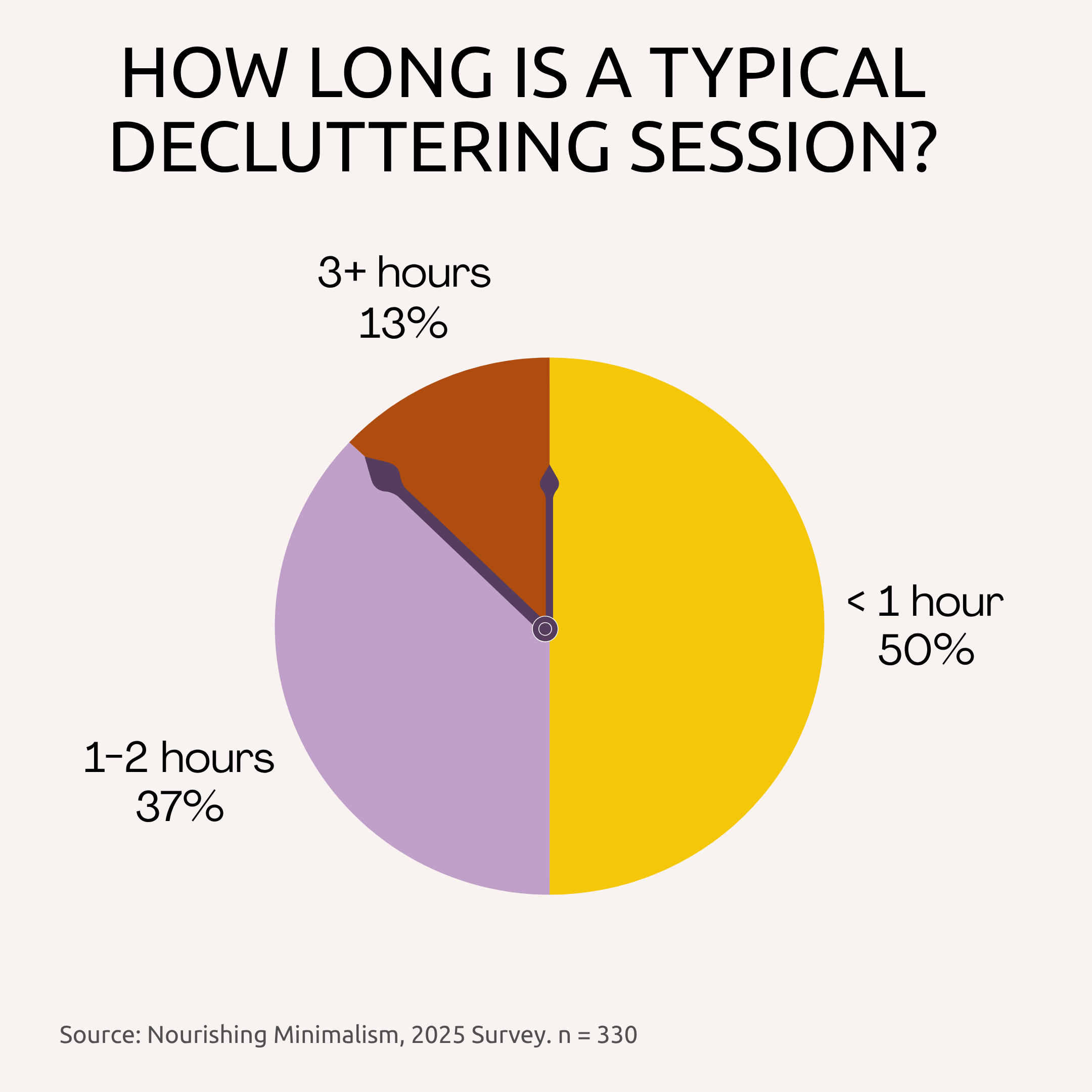
It’s all about consistent progress and avoiding burnout. You COULD force yourself into several hours of decluttering, but what are the chances you’ll return to the job tomorrow if you do that? Quite low, actually.
From what I’ve seen and heard from clients, short and frequent decluttering sessions will give you better results.
Which area of your home do you spend the most time decluttering?
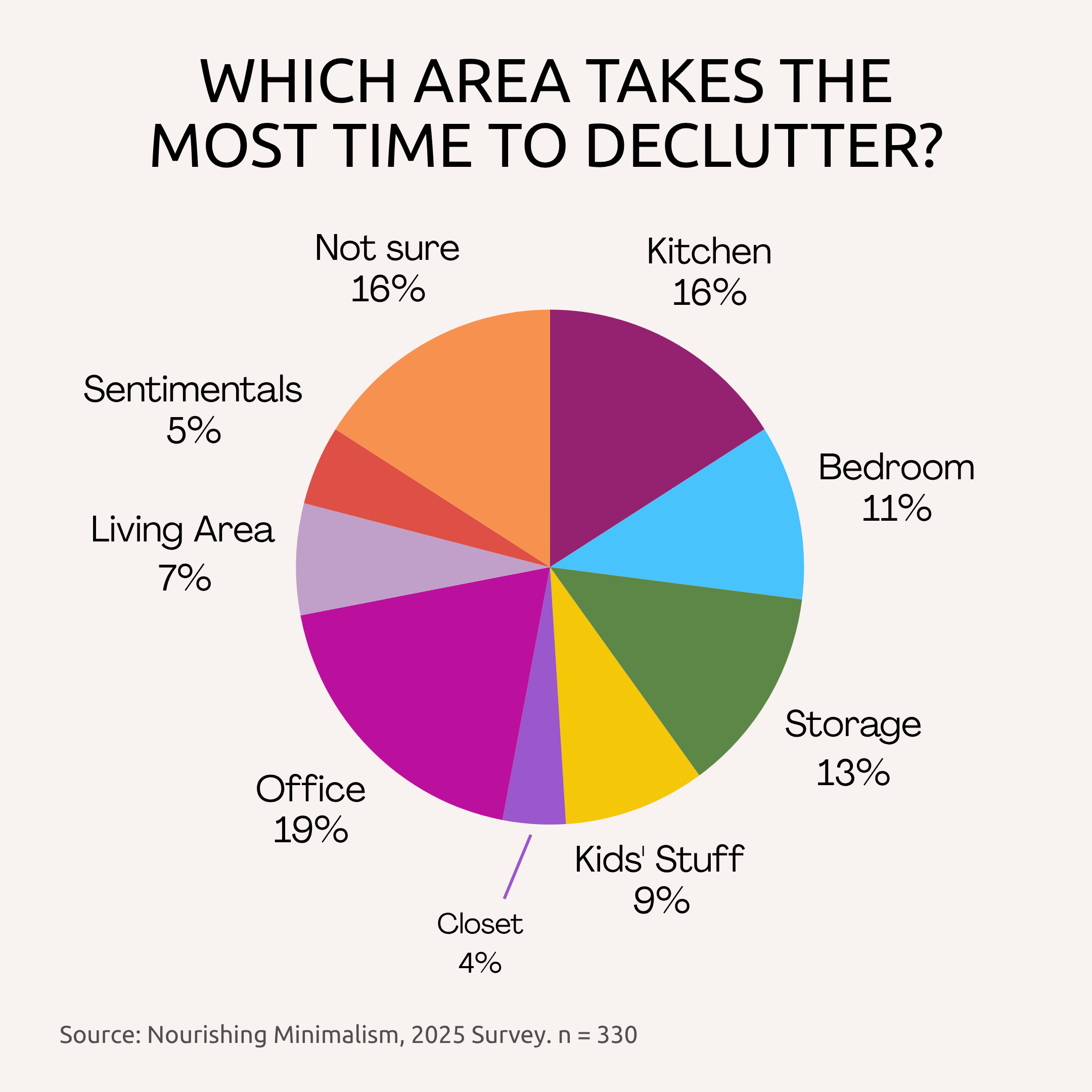
According to our readers, they spend the most time decluttering their kitchen and office/paperwork. That makes sense, since these two categories tend to collect the most clutter due to utility–i.e., it’s where we store our tools.
A decluttering formula for the whole house.
Here’s one way to determine how long it might take to declutter an entire home. Here’s the formula:
Total Time = (Total Areas x Avg Items per Area x Average Time Per Item) ÷ Efficiency Factor
And here’s a breakdown of those variables.
Total Areas: Count the number of rooms/spaces to declutter.
Avg Items per Area: Estimate the number of items per space. (Small room: 300–500 items. Kitchen or garage: 1000+ items.)
Avg Time per Item: Estimate time it takes to handle one item. Usually:
- Quick decision: 10–30 seconds
- Harder decision: 1–2 min
- For ease, you might average it at 0.75 minutes (0.0125 hours) per item.
Efficiency Factor: This is to account for breaks, distractions, energy levels, etc. You might use:
- 1.0 for very focused sessions
- 1.5–2.0 for average productivity
- 2.5–3.0 if you have ADHD, chronic illness, or kids underfoot
Let’s say you have 10 areas, each with around 500 items, and you’re at average energy levels:
Total Time = (10 × 500 × 0.0125) ÷ 1.5
= (62.5) ÷ 1.5
≈ 41.7 hours
That means about 42 hours total. At 1 hour/day, that’s 6 weeks. At the average session (based on our 2025 survey) of 30-minute sessions, it would take around 84 sessions to fully declutter your home.
Play with the values in the calculator below to get a better idea of how long your home will take to declutter.
Home Decluttering Calculator
🏠 Decluttering Time Calculator
Doing your own calculations.
If the formula above seems sketch for your situation, that’s fine! It’s hard to nail something so qualitative and get an accurate assessment, so here’s your second option.
Track real-time data for 3-5 spaces as you declutter, then project the average across the rest of your house.
For example, if you declutter two surfaces, one pile on the floor, and a small hallway closet, you can average how long those areas took you, count up the rest of the “areas” in your home, then multiply the average by the areas.
Total Time = Average Decluttering Time x Number of Areas
So let’s say that Surface 1 took 20 minutes. Surface 2 took 30 minutes. The pile on the floor took 15 minutes. The small closet took an hour.
Average Decluttering Time = 31.25 minutes
Then count the “areas” in your home–let’s say there are 45.
Total Time = 31.25 x 45
That means we can estimate it will take 23.5 hours in total to declutter your home.
Where to start decluttering.
To strategize your decluttering journey for efficiency, you might be wondering about the best place to start. Here are a few options:
- The easiest–tackling the simplest area first can build your confidence and momentum.
- The most impactful–even if it’s tougher, it might be best to start with the area that will most improve your daily life, like the kitchen or entryway.
- The least sentimental–for my declutterers who struggle with sentimentality, you might try with the LEAST sentimental area, like the garage or laundry room.
Which area of the home is the easiest to declutter?
According to our readers, the kitchen is by far the easiest area to declutter. This is probably for a similar reason that readers claimed the kitchen takes the most time to declutter–it’s a utility area. The clutter in our kitchen often holds the least sentimental value. We also tend to collect the most duplicate items here, which are easier to part with.
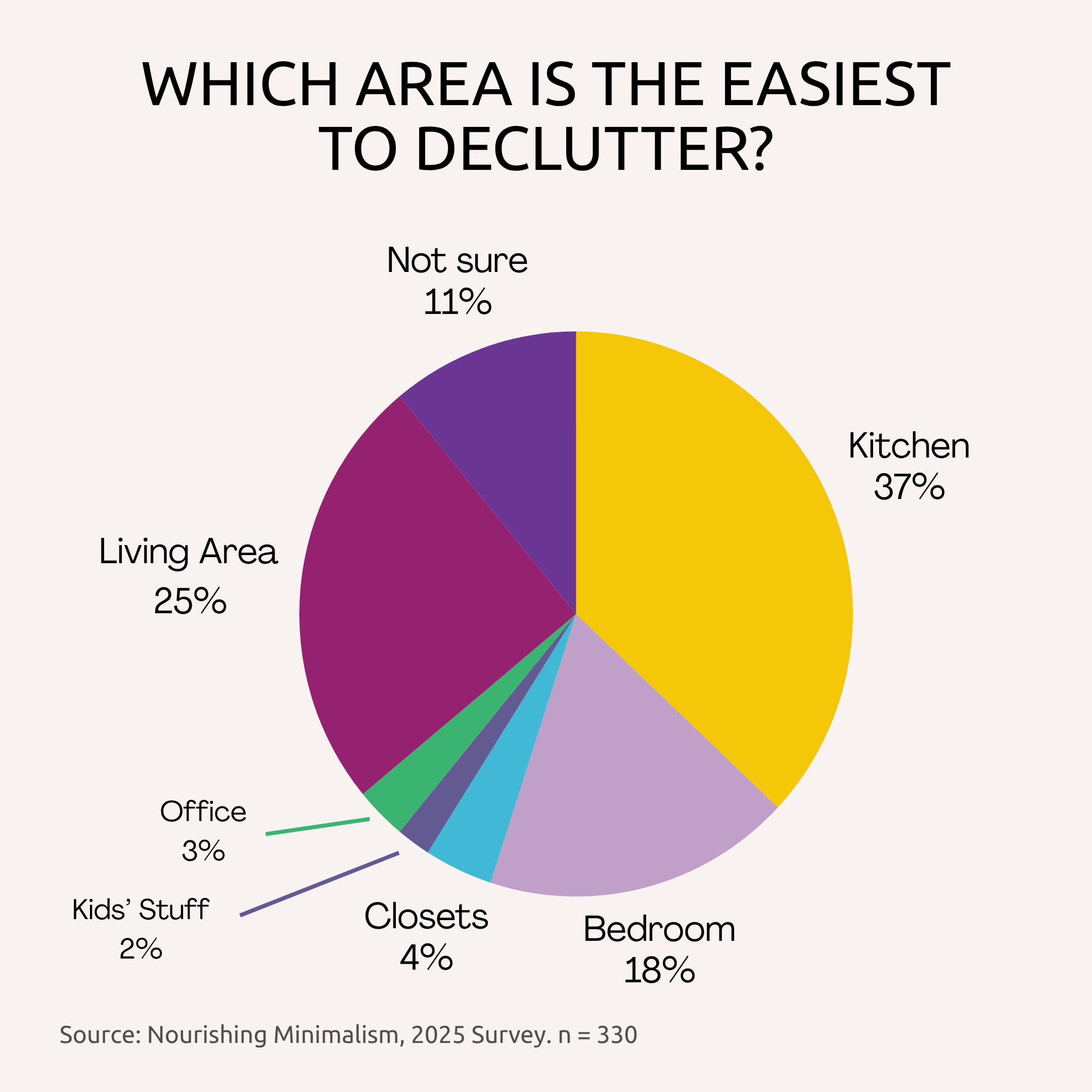
“Living area” refers to living rooms and dens. “Office” refers to home offices and papers of any kind.
How to stay motivated to declutter an entire house.
So how can we buckle down for the long haul and finish decluttering our whole house? Our readers had some insight.
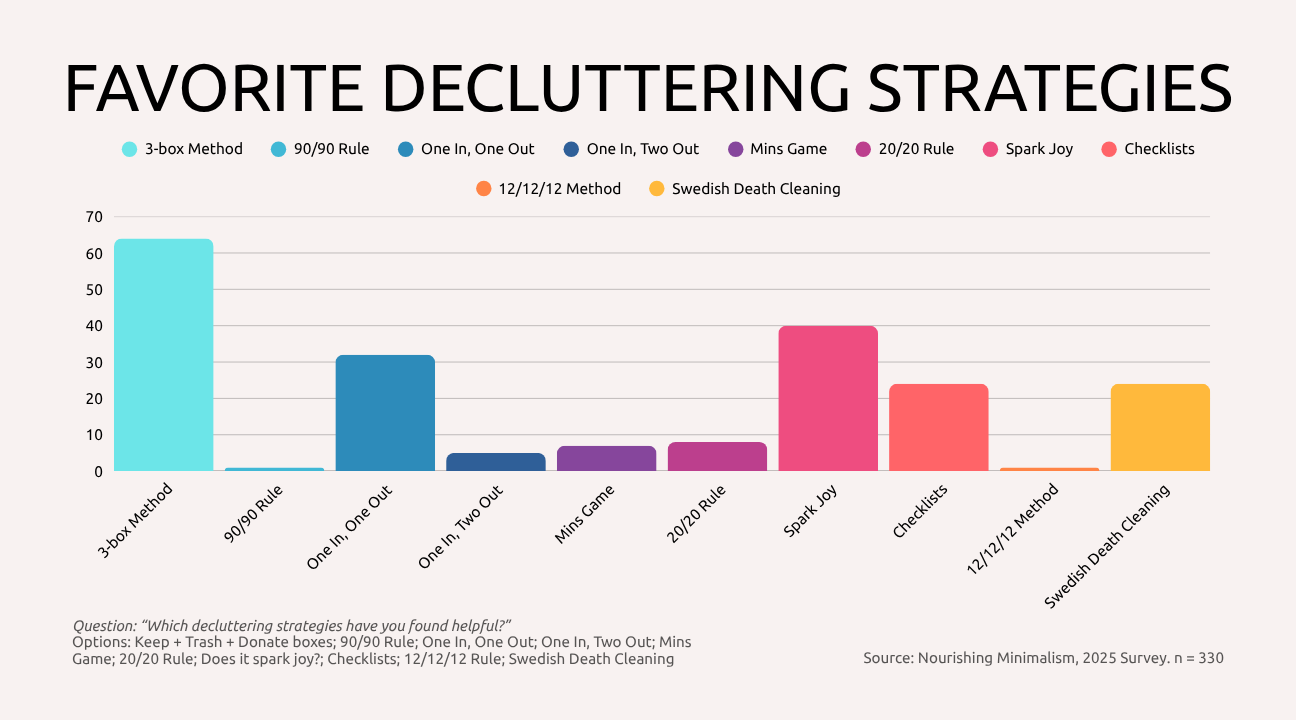
Which decluttering strategies have you found helpful?
The 3-Box Method.
Setting yourself up for success with this simple sorting method proves most effective. Have a container on hand for donations, for keeping (and rehoming elsewhere in the house), and trash. Trash can easily be a bag–don’t take “box” too literally here. Do what works.
One In, One Out.
The OIOO rule (and its brother, One In, Two Out) is the simple practice of decluttering one (or two) item(s) every time you bring something new into the house.
Mins Game.
Mins Game is the monthly decluttering challenge coined by The Minimalists, where you declutter one item on the first of the month, two on the second, etc. By the end of the month, you’ll have decluttered hundreds of items.
20/20 Rule.
The 20/20 Rule helps when you’re stuck on a tough decision–ask yourself if you can replace that item within 20 minutes for under 20 dollars. If the answer is “yes,” you can feel more confident decluttering it.
Does it spark joy? The classic question posed by Marie Kondo. If you hold an item and don’t feel joyful about it (and if it doesn’t serve a vital function), you can feel more confident decluttering it.
Checklists.
Checklists and tally charts are a popular tool amongst declutterers. When you’re faced with vast piles of thousands of items, a checklist can help you hone in and take one step at a time.
Swedish Death Cleaning.
Swedish Death Cleaning refers to the no-nonsense approach to decluttering where you strategize based on what will make things easiest for your loved ones upon your passing. I was surprised to see such a big turnout for this strategy in our survey, even though it’s one of my favorite frames of thought for decluttering.
Most helpful decluttering tools.
We asked our readers about their favorite decluttering tools, and here’s what they said.
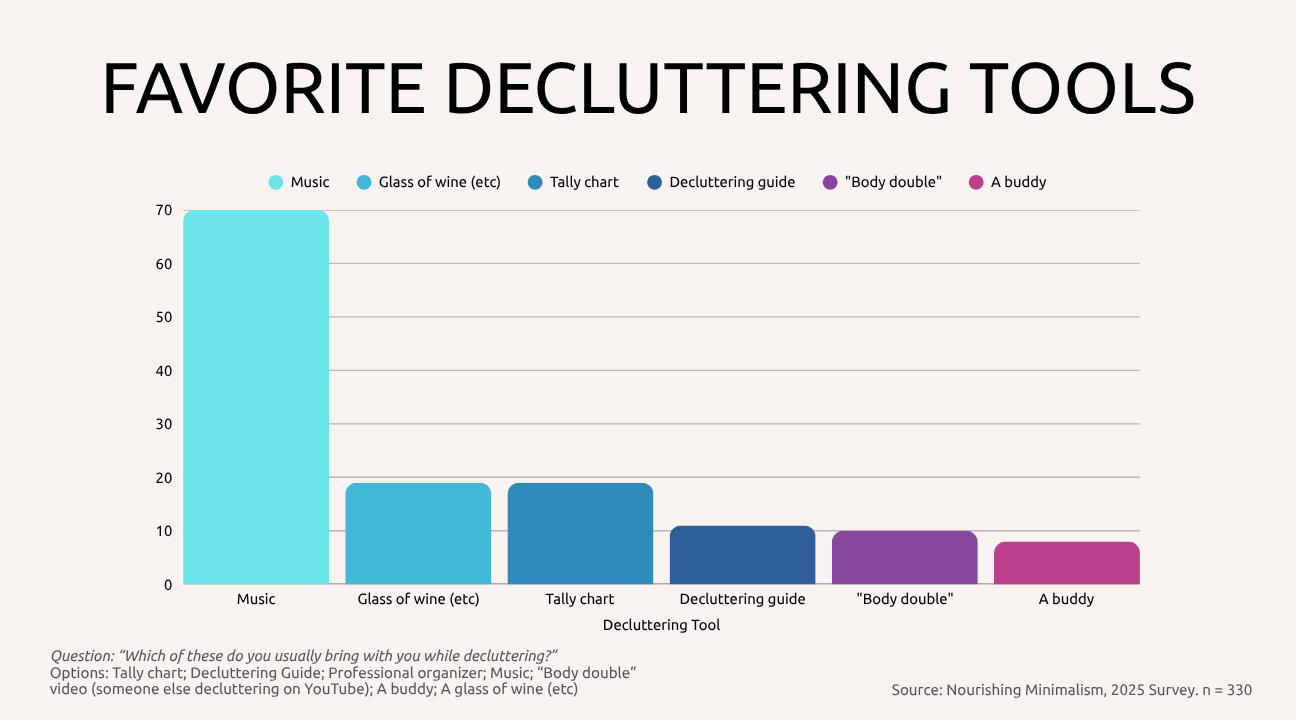
Music, body double, buddies, and a “glass of wine”–i.e., vibe setting.
These factors are all about setting a pleasant decluttering environment for yourself. Settling in and getting comfortable is the best way to make something a long-term habit. The more enjoy it, the longer you’ll do it.
The results of this question really prove that the #1 factor of longevity in your decluttering sessions is your own comfort.
Tally charts.
If you’re a regular here at Nourishing Minimalism, you know we LOVE a tally chart. I assume many of the respondents here are using one of our charts, whether it’s the annual decluttering challenge, Mins Game charts (shoutout to The Minimalists, originators of the Mins Game challenge), or any of the other special occasion tally charts we offer free to download.
Decluttering guides.
We offer many decluttering guides on our blog, from our comprehensive blog post on the topic to our harder core offerings like the 30-day Home Heal program.
Another option included for this question of the survey was “professional organizer” but exactly 0 of our 330 survey responses chose this option. I find that encouraging! You can do this yourself!
Declutter Your Home Quickly
Wanna streamline the decluttering process and get your whole home under control quickly? Try our Clutter-Busting Charts! This is a room-by-room game plan to help you move from chaos and clutter to serenity and simplicity, fast.

