
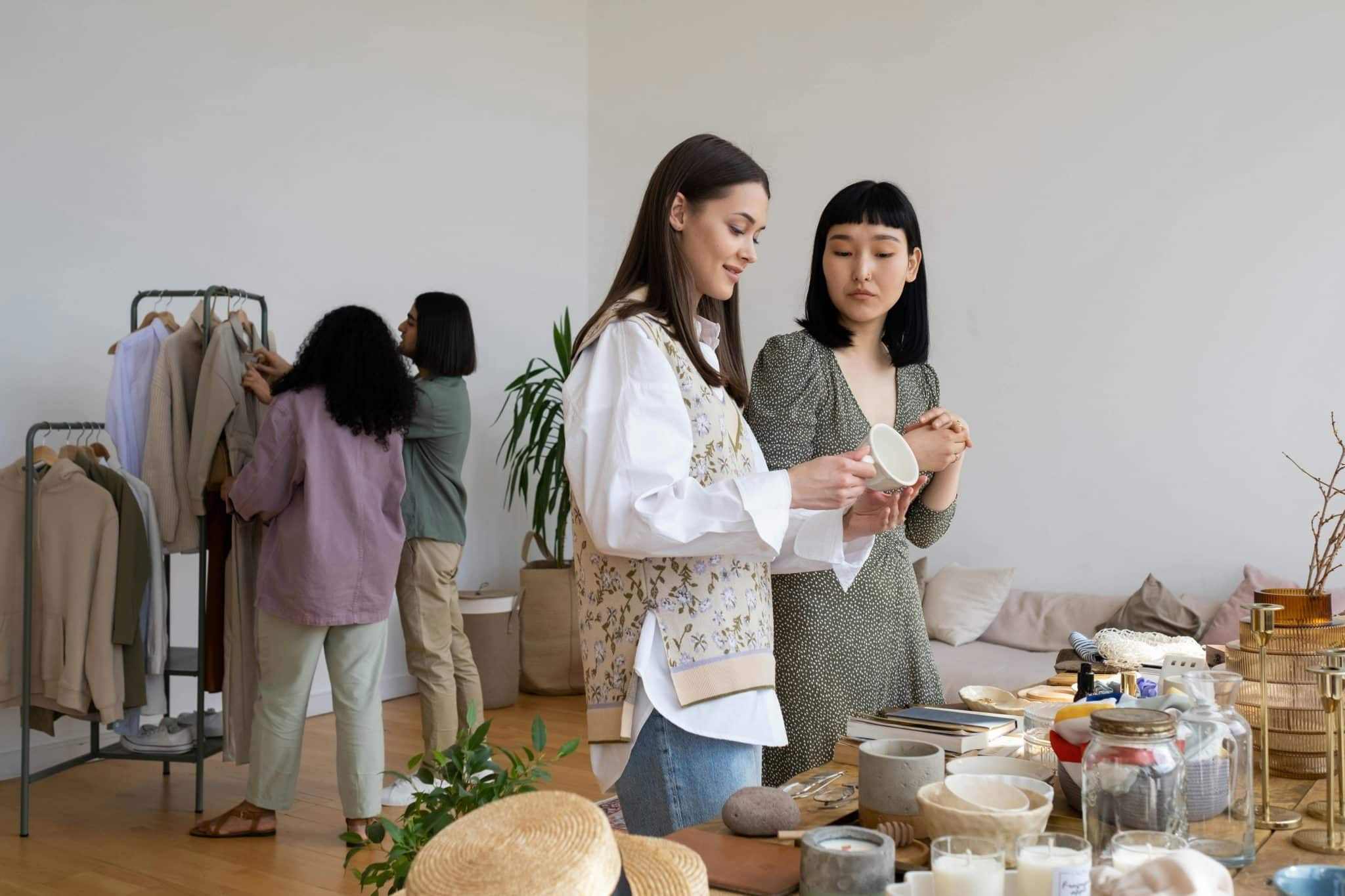
I LOVE a clothing swap. It’s a fun way to practice sharing and community organizing, to connect with neighbors, and for everyone to get a little wardrobe refresh without spending a dime. Plus it gives everyone a great excuse to finally declutter their closet!
In my core friend group, we share clothes ALL the time. It makes me giggle to see the same shirt making the rounds every few months. That’s our tattered tee, and it’s a part of the family!
Let’s go over why swap parties are awesome, how you can set up a clothing swap party, a few tips and best practices, and what to do with all the leftovers after the party is over.

Why should I host a clothing swap?
In my mind, there are four excellent reasons that clothing swaps are a great practice.
1. Everyone has an excuse to declutter their closet.
The closet is a tough area to tackle for decluttering and organization, but if you can make it fun? Amazing!
While you go through items to get rid of, you might get excited about how it might look on a friend, or how much someone else might love it, or what you might trade it for. Then the process becomes fun, and you have a specific timeline to get it done.
Read more: 6 Ways I Simplified My Wardrobe Without Going Full Capsule
2. It builds community and fosters sharing.
Anything that brings people together is a win in my book. It’s an easy way to practice offering and accepting help and collaboration from your community.
Read more: How To Host A Crappy Dinner Party
3. New clothes for free!
And of course, you’re upgrading your wardrobe for some pieces you’re more excited to wear! Without spending a dime.
4. It’s an easy way to practice non-capitalistic survival.
In the U.S. in particular, our culture revolves around money. Making money, spending money, loving money. And we have to spend more money when our communities are weaker. If we’re not in the practice of sharing with each other and supporting our neighbors, living is more expensive.
My favorite example is lawn mowers–why does each house own a lawn mower? Why couldn’t a neighborhood block share one, pitching in the money to buy it, the effort to maintain it, storing it in the best shed amongst our homes?
We could! That would be better for everyone.
Except for one party…the people selling the lawn mowers. They benefit from everyone being “independent”, from tall fences separating our homes.
Each lot must contain one (1) family with two (2) adults and a couple kids, and each family needs their OWN individual lawn mower.
That way Mr. Mower can sell one to every single household.
Do you see how for-profit companies benefit from influencing individualism? And how EVERY company would have the motivation to work together, with their billions of advertising and influential dollars, to encourage us to turn away from community living?
It’s intentional. They’re grooming us through media and marketing to tell us how to live so they can get more of our money.
But we don’t have to listen. We can fight the flow, take the hands of our friends and neighbors, and all swim down together.
Simple, easy practices like sharing garden tools and hosting swap meets can teach us how to turn to each other, to share, to barter, to keep more of our money in our communities instead of handing it all up to the overlords.
Something to think about!
Anyway, bit of a tangent, here’s how you can host a clothing swap party.
Invites and clear guidelines.
Use clear guidelines to let people know what they can bring. You can also ask what sizes they plan to be bringing. Perhaps have a group chat for it.
Sizes. Guidelines can include sizes, if you have a small enough group that you know the boundaries, you could ask the smallest person for the smallest size they wear and the largest person for the largest size they’d wear, then use that for your range.
Quality. Guidelines can also include quality. You might want to say no stains or tears, and please wash the clothes before you bring them. Or maybe you’ve got some sewing aficionados in the group who would love to repurpose damaged pieces–it just depends! Either way, let everyone know the expectations for smoother sailing.
Amount. Setting a minimum might be difficult, but you can certainly set a max number considering space availability. It’s also good to give people a general idea–“please bring between 5 and 20 items” can be quite instructive so no one brings 300+ items that overwhelms the space and leaves them feeling disappointed that they don’t have as many options to choose from.
Type. You might want to throw a swap for something quite specific, like office appropriate attire, shoes and accessories only, or even a particular style preference.
Example. If I were throwing a clothing swap next week, here’s a text I might send.
To: My artsy and eclectic friends, all genders. (It’s good to keep the general style of the group in mind to invite the most effective folks for that particular swap.)
Hey guys! Clothing swap at my house this weekend? Anything decent quality between sizes M and XL–wear is fine, but please wash them first! Cap at 25 pieces per person, since it’ll be in my living room. Shoes and jewelry are welcome. ☺️
If you’ve never done a swap of any kind, you may need to include more context in your invite or even speak to people individually beforehand to get everyone on the same page. Your second try will be much easier! It’s okay for this to be something that you practice and improve upon. Show up imperfect, learn what you can, and improve next time–great advice for any pursuit!

The event itself.
There are many options for hosting a clothing swap, depending on your space, how many people are coming, and how many items you expect each to bring. Here are a few general tips you can edit to suit your situation.
Indoors vs outdoors.
If you’ve got lots of folks coming, or if you’re opening it up to the whole neighborhood, outside is probably your best option. You’ll need racks or tables to hold everything–think yard sale. Don’t forget to check the weather or have a rain plan!
If it’s just you and a few besties, hosting it inside should be fine!
Regardless of where you’re having it, you’ll probably want:
A try-on area. This can be a bathroom or bedroom, a rack with a curtain hanging over it, or just a full-length mirror in the middle of the room if it’s you and a couple close friends.
A clothing area. You can use a table, clothes racks, or blankets spread on the ground to hold the clothes up for consideration. If everyone wants to bring their unclaimed clothes back home with them, it might be a good idea to provide a separate area for each person’s things to keep track.
Music and snacks. Music and snacks aren’t required, but they’ll really up the vibes. Maybe make a pitcher of lemonade or bring a few bottles of wine for sippin’. A plate of cookies or a veggie tray wouldn’t be unwelcome additions either!
What to do with clothing swap leftovers.
Now what about afterward, when everything has been picked through and YOU’RE left with a thrift store’s worth of stuff?
You’ve got a few options, depending on your situation.
Do the original owners want the unclaimed pieces?
I’ve been to a clothing swap with wealthy, fashionable people, and every piece could’ve been resold for $100s. These people typically kept track of which clothes they brought, then they collected them at the end and took them back home.
On the other hand, I’ve also done clothing swaps with groups of people who are frugal and already thrifting all of their clothes, so many pieces weren’t so desirable. They were damaged, worn, or a niche style. Usually, the owners weren’t worried about keeping the unclaimed pieces.
If your group wants to hang onto their unclaimed clothes, you’ll simply need a system for keeping track of those items. You can use tags or stickers ahead of time, or keep items separated by area.

Haul it off to a local charity or Buy Nothing Group.
If the group wants, you can offer to round up the leftovers and drop them off at a designated charity donation center. This is the most straightforward and lowest effort solution.
Repurpose.
Or you can double your fun and have a project in mind for the leftovers! Maybe tell the group you’d like to start a quilting club, then use your clothing swap party as a way to collect materials.
Of course, you don’t NEED to include everyone in your repurposing plan, but you can have something in mind for the scraps and let them know about it. People like to know their things aren’t going to go to waste.
Either way, decide ahead of time what will be done with the extras so you aren’t left with a million pounds of textiles, and so everyone knows what to expect going into it.
Other items for swap parties.
If you have so much fun with your clothing swap, maybe your mind is starting to turn with other group sharing possibilities… Here are a few ideas.

Home decor swap.
Home decor is another great category for swap meets, because pieces tend to hold their value really well, and you don’t need to buy something brand new for it to FEEL brand new in your home.
Read more: How To Declutter Decor
Children’s toys.
Fantastic around the holidays if you’re trying to be frugal or low waste. Plus, there are tons of amazing causes that take gently used toy donations this time of year for whatever is left after.
Kid’s toys are one of those categories we tend to have a TON of–and they’re usually in good shape! But the kids have their favorites, and at some point, you CAN have too many, so it’s great to downsize and curate the collection. Most kids are happy to swap ten old toys for one “new” toy they can get excited about.
Art, craft, and school supplies.
Maybe you had some hobby flops that weren’t as fun as you expected, your kids outgrew some school supplies, or you bought a massive bulk amount of brown twine you couldn’t use up in your lifetime. This is a great category to swap!
Plants.
You can get a group together for swapping house plants, propagations, or even food-bearing plants for the garden.
You can plan even further ahead by getting a group together before the growing season starts and assign a plant for each person to start from seed. Maybe one friend does herbs, one does peppers, and so on–it’s often easier to grow a ton of one plant than it is to tackle all of them on your own.
This way everyone can hone in on perfecting their process, getting really good at growing one thing, and everyone can benefit from having healthy and tended-to plants to start their gardens! I’m also a huge fan of community gardens, obviously.
Read more: Is there such a thing as too many houseplants? Minimalist Plant Collection
Workout equipment.
Sometimes we have exercise machines we thought we’d love, but never actually use. And sometimes we grow out of stuff, like lighter weights from earlier in our fitness journey. Exercise equipment is a great category to declutter and share, because they tend to be expensive and any opportunity we have to bring wellness into the forefront of our minds and communities is a plus.
Costumes.
Before Halloween or a costume party, you can get together with your friends to swap or borrow each other’s costume pieces. They don’t even have to be traditional costumes–bring old jewelry, random hats, weird clothing items, etc. This one can turn into a whole house declutter sweep.
Will you try a clothing swap party?
I hope I’ve convinced you to give it a try! It can really be as simple or as complicated as you’d like it to be. I recommend starting with just a handful of friends to get a hang of it, then slowly expand.
BONUS IDEA: Make it a monthly event! You could run it like a book club–meet at a different friend’s house on a designated day each month. Whoever is hosting chooses the category of items and any additional parameters.
To slowly grow it, each participant can invite one additional friend. If that bonus friend enjoys the process, they join the roster. Then everyone brings a new friend to the next one. Exponential growth at a controlled paced, since not everyone is going to want to join in and you can stop adding people whenever it feels you’re at capacity.
What do you think? Have you been to a clothing swap before? Got any tips of your own to add? Let us know in a comment below!
Happy hosting! 💜
