

I don’t know about y’all, but the difference in my productivity levels when my office is minimal and tidy versus when it’s cluttered and chaotic is actually staggering. Focus comes easier, I can stay on task longer, and I just feel better.
Let’s talk about how to effectively declutter your work space–from what you should keep on your desk, to dealing with tough categories like papers and cords, plus my favorite office organization tips.
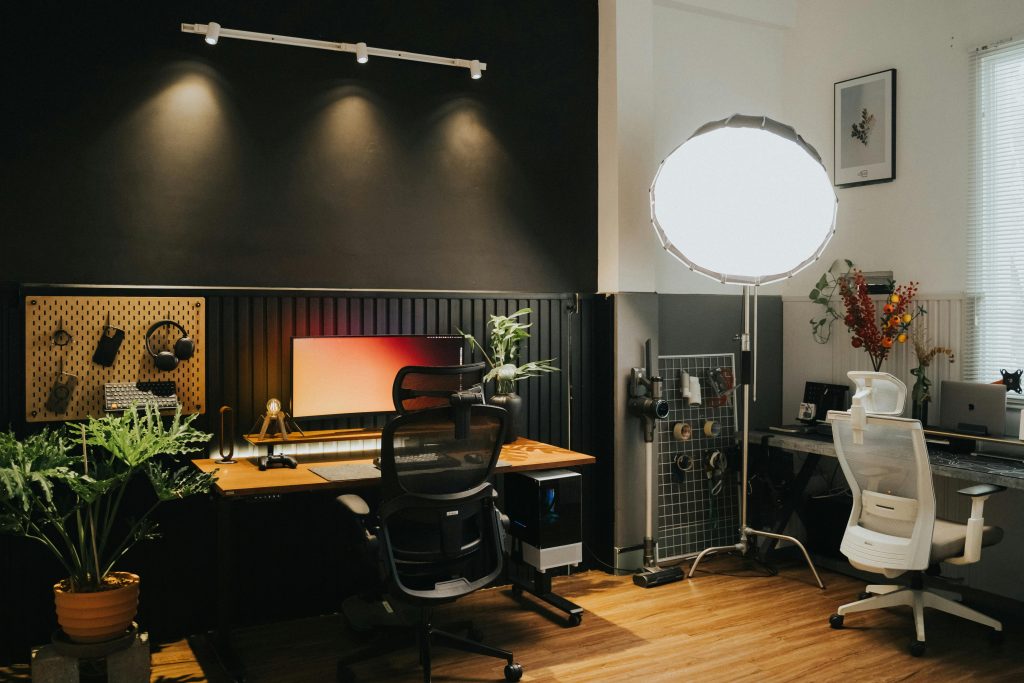
What should a minimalist keep on their desk?
I have a great hack for determining what needs to live on your desk without all the guesswork. Here’s what you do:
- Shove everything from your desk into a box
- Keep the box under your desk for a week
- As you use items, put them back on your desk
- Everything left in the box can be decluttered or put into less immediate storage
This way, you know exactly what YOU use on a regular basis.
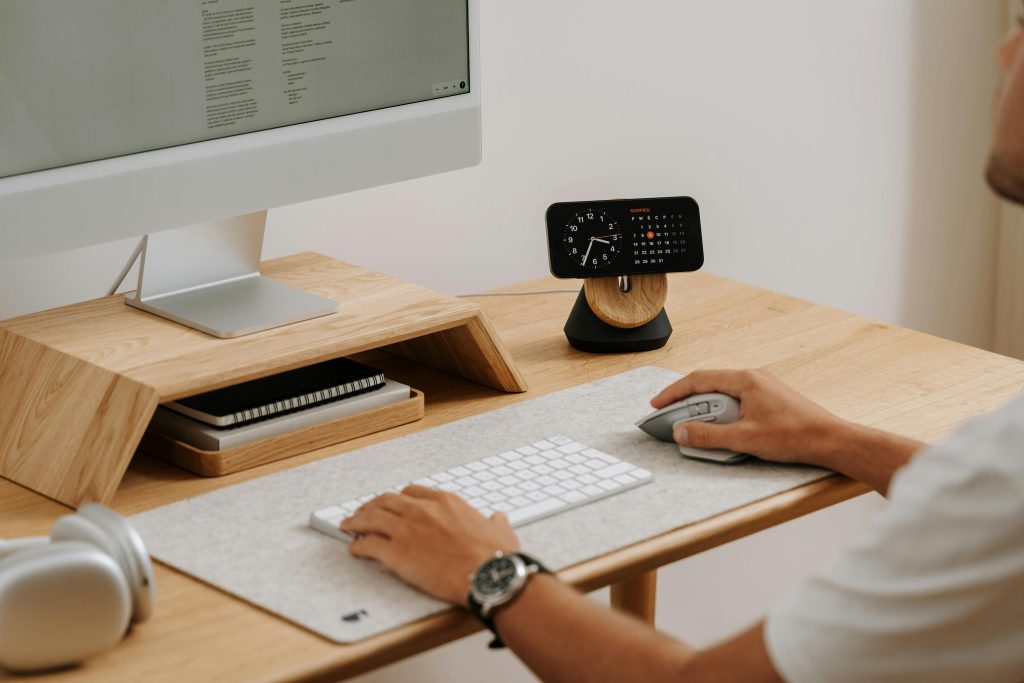
Ideally, you have as few things as possible on your desk. Right now, I have my laptop, my extra monitor, the box my extra monitor sits on, and a coaster for my drink. My headphones and walking pad controller hang on hooks on the side of my desk.
(Writing this post actually inspired me to finally buy monitor arms that attach to the desk so I can have more surface space. I ordered the arms and a second monitor to match my current one–which was a hand-me-down–from ebay, so the whole monitor setup ran me under $120. Telling you about it because I feel accomplished. Thanks for listening xoxo.)
Decluttering papers
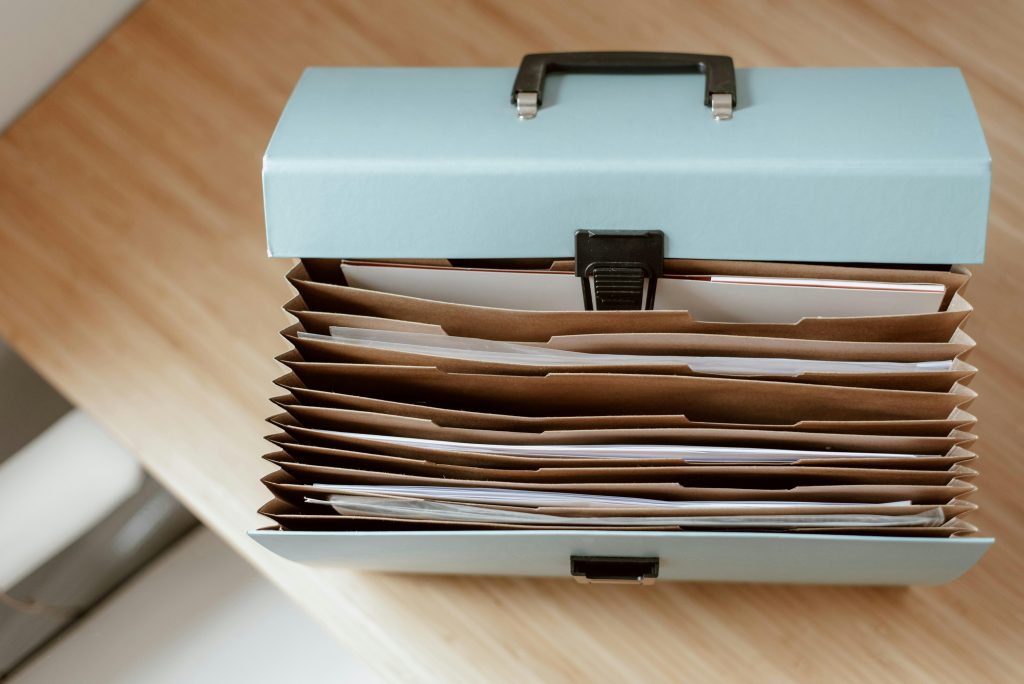
Paper clutter is pervasive in many homes, particularly in the office. You might have piles and piles of junk mail, pamphlets, documents to file, documents to shred–and maybe none of it is organized at all.
Here’s a full guide on dealing with paper clutter: How To Get Rid of Paper Clutter Forever.
And here’s the strategy I recommend.
1. Collect it all. Gather all those paper piles from around your house into one place. If you end up with several child-sized piles of them, you might want to temporarily dedicate an area of your house to this project, because it’s not gonna get done in one day.
2. Determine sorting piles. Have a plan going into it so you don’t get hung up on decisions. You might have:
- To file or digitize pile
- To destroy pile
- To act upon pile
- Too-nervous-to-get-rid-of-this-right-now pile
Having your piles decided upon ahead of time helps you make quicker decisions instead of looking at a piece of paper and seeing a whole world of possibilities for it.
Having an “I’m not sure about this yet” option also makes the process quicker. You can address that pile after you’ve dealt with the rest because you’ll have a better idea of what you have, and you’ll have sat with the possibility of getting rid of it.
3. Get comfy. I recommend sorting papers with a show or podcast or friend to keep you company, because it’s such a painful chore that many people dread. Make it a little less intimidating by creating a comfortable environment for yourself.
4. Do it in sessions. You might not be able to sort through everything in one sitting–that’s fine! Grab a stack each evening to watch your show, or sort while you’re chatting. Just make consistent progress at a sustainable pace, and you’ll be done in no time. Or in two weeks.
5. See to the piles. After you’re done sorting, it’s time to address the piles. Tackling one pile per day might make sense for you.
Here’s the order I recommend:
- Shred or burn your “destroy” pile. Maybe you have a bonfire, maybe you have a date with your shredder, or maybe you drop it off at a print shop that offers shredding services. This is the easiest pile to deal with, so I like to do it first to feel like I’m making progress.
- Next, address your “to act upon” pile. Maybe it’s paying bills, responding to letters, or returning an item. This might require running errands, so dedicate at least a couple hours to working through this pile.
- File or digitize what you need.
- With those three piles gone, you can refocus on sorting your “not sure” pile. You should be able to sort it into the other three categories: File, do something, or destroy. Hopefully letting those decisions sit for a while has made them clearer. If not, you’ll have more cognitive capacity to deal with it than you had earlier, because you have a much smaller pile looming over you.
Decluttering cords and chargers
Wires are another hot category for home office clutter. For wires in use, I HIGHLY recommend some wire management, like using clips to get them out of your way. It makes a huge difference in how the room looks and feels.
Then for the unused cords… Here are a few questions to ask:
- Do I know what this goes to?
- If yes: Label it if you haven’t, wrap it neatly, tie it up.
- If no: Drop it in a designated “idk” box.
- Can this be useful somewhere else? For example, an extra phone charger in another room or the car.
- If yes: Bring the charger to that area and set it up in its new “home” for extra convenience. Or attach an HDMI cord to each TV set, coiling it neatly in a wire clip for the next time you need to attach another device (this works for my house because I love vintage game consoles, but if it’s not relevant for you, skip it!).
- If no: Drop it in the “idk” box.
- Have I used this in the last year?
- If yes: Consider keeping.
- If no: Drop in the “idk” box.
- Do I have multiple of this?
- If yes: Choose the best ones and drop the others in the “idk” box.
- If no: Consider keeping.
Now, the “idk” box serves an important purpose–you can let another discerning adult in your household and/or your most tech-savvy child help you identify the leftover wires. This also gives them a chance to say, “Oh, I have a use for this!”
After your trusted adult or child has looked through the “idk” box, you can feel more confident decluttering what’s left.
If you’re super anxious about letting go of cords (this is like papers, where we tend to get hit with the “what if I need it” apprehension), then you can close up the box, date it, and put it somewhere out of sight.
In the next six months, if you need one of those wires, you can go grab it. If six months pass, you can feel confident getting rid of the whole box.
Should you get rid of extra office supplies?
One more tough category in this room is office supplies. Pens, paper clips, notepads, and so on. It can feel wrong to get rid of these things because they are TECHNICALLY useful, but we tend to hoard way more than we need.
My first suggestion is to stop buying office supplies. We so rarely need a restock. We’re just in the store and see something cute and tell ourselves we’ll be more productive with the new notebook or the new highlighters or a new organizer.
Next, ask yourself how frequently you’re actually using those things. I had a huge stockpile of office supplies because I’m an author. I buy stuff for myself, other people gift me supplies because they think, “Well sure, she probably needs more pens.”
(I don’t need more pens.)
I’ve decluttered my office supplies again and again, to the point that what used to be BOXES full is now one small drawer. And here’s the thing–I STILL HAVE TOO MANY POST-ITS.
Unless you have a real use for office supplies (maybe you’re a teacher, or an? accountant? idk what accountants do), you’re probably good with a notepad and a couple pens. Really.
The time I need the most supplies is when I’m line editing a book. And even then, I don’t use up half a pen and highlighter. And that’s my BIG project that would require the most supplies.
So clearly I did not need several boxes of supplies. I STILL have more than I need, and every time I declutter, I let go of a little bit more.
It’s okay to go in layers like that–over time, we build confidence in our decisions and realize that our lives are actually fuller and more free with less clutter. So you might only let go of some of it now, but you can always come back and get rid of more later.

Minimalist office furniture
I recently reevaluated my office and moved a few pieces out. I have a very tiny room for an office, and it feels SO much better to have a more space.
Arranging my desk to where I can walk right to it from the door also lowered the physical barrier to getting started in the morning. Before, it felt like I had to pick through a maze to get to my chair. Anything you can do to remove physical annoyances will make your day run a little more smoothly.
Consider each piece of furniture in your office:
- Do you use it?
- Do you like it?
- Does it fit in the space?
- Would the room function better without it?
- Does it need repair or cleaning?
- Does it need to be replaced?
What purpose does the room serve?
If you want your office to be exclusively for work, then you might benefit from clearing everything else out of it.
But maybe it’s also a library. Or where your kids do their homework. Or your crafting space.
Determine what purposes your office serves, then interrogate each item in it–if it doesn’t serve one of the stated functions of the room, then it should be removed.
This makes spaces much more functional, focused, and is a good guide for decluttering decisions.
Note: Obviously, decor doesn’t fit into this framing. For decor, just ask yourself if you enjoy having it there!

Office organization tips
Here are a few extra tips you might keep in mind while you’re organizing what’s left!
1. Keep only what you use. This is truly the best way to create an organized and functional space. An effortless method to determine what’s used is with the box strategy above.
2. Label everything, especially wires and containers. It’s easy to feel like we’ll just know or remember what things are for, but decluttering your wire collection earlier probably taught you otherwise. Label things while you still know what they are! It’s such a low effort way to reduce friction and confusion down the road. Do future you a favor.
3. Assign a home to every item. This means EVERY single thing has a place to belong. If you can’t find a home for something, or if you feel irritated trying to do so, that’s usually a sign that it’s time to let it go.
4. Optimize for ambience. While we’re thinking about the office, how is it as a working environment? Is the light, noise, or air quality uncomfortable? Do things distract you? A little bit of attention to these details can go a long way in optimizing for productivity.
5. Read this post for more home office styling and organization ideas: 30 Creative Home Office Ideas for a Stylish and Productive Space.

Excellent article with a personal touch. Love the “idk” box. Youare inespiring me to sort through my papers!