


Two of the hardest D’s in the world are decluttering and depression. But have you ever tried decluttering WHILE depressed? Phewie.
It’s tough. It can feel downright impossible. Sometimes it feels like fighting against your whole world.
While it can be an intense and intimidating experience, here’s why decluttering is worth it anyway.
We have mountains of research about the links between clutter and depression. You can read The Clutter-Depression-Anxiety Cycle for more specifics, but the gist is: Clutter negatively affects our mental health. Poor mental health makes it harder to keep a tidy space. More mess = more mental health issues = more mess, onto infinity.
Creating a clutter-free and peaceful environment for ourselves is an incredibly kind thing we can do for our mental and physical health. It’s SO worth the fight.
Let’s talk about the emotional and mental weight of clutter, how you can still take tiny steps to push through and make progress while depressed, and our best tool for finding success in decluttering with depression.
A cluttered environment has a negative impact on your mental health, everyday life, and overall well being.
Just the mental load of a cluttered environment is enough to wear you out. Every item feels like a decision, a chore, an undone task.
With depression comes a physical fatigue and lack of motivation. And not one of those, “I just don’t feel like doing anything today” types of no motivation. It’s often an impossibly heavy, all-consuming, overwhelming lack of motivation.
With conditions like depression, ADHD, and others, executive dysfunction and time blindness can also have a big effect on why decluttering is so difficult. When cognitive overload meets excessive clutter, you’re left trapped between with no idea of what direction to turn toward.
Clutter is also emotionally loaded. When sorting items, you might find yourself tangled up in trauma loops, grief, and shame. Sometimes we have to process traumatic events, untouched emotions, and maybe even repressed memories, just while we’re touching our clutter.
Overall, decluttering with depression often starts (and prematurely ends) with: “What do I do first?”
So let’s talk about what you should do first, and how to make sure it actually happens.

How to declutter while depressed.
Here are five things you should keep in mind when approaching clutter while managing your mental health.
1. Prioritize your physical health
So often, dealing with mental struggles makes us feel like we need to chase happiness, fight off negative emotions, and simply force ourselves to feel better.
But in actuality, the pursuit of happiness usually gets us even further away from it. (Sorry, Thomas Jefferson, ya can’t win ’em all.)
When we fixate on creating a particular feeling or state of being, we tend to skip the practices that would ACTUALLY help us feel more peace and contentment.
An easy way to avoid this pitfall is to focus on your physiological needs.
Are you hydrated? Rested? Fed? Have you moved your body today? Have you gotten any sunshine? Have you had a good hug lately?
These are “easy” things to accomplish–or, they’re at least tangible things to accomplish.
Not only does physical wellness lead to increased mental health, but having something REAL to focus and improve upon helps us feel useful and in control.
So use this checklist when you’re feeling bad to get the obvious stuff taken care of.

Feeling bad checklist
□ Drink water (and electrolytes)
□ Eat (preferably something nourishing, but anything will do)
□ Nap or lie down for fifteen minutes
□ Have a shower (or a wipe down on the couch–whatever feels doable)
□ Take a gentle walk around the block, or just sit outside for a few minutes
□ Journal or meditate
□ Have some human contact with a loved one (or just send a “love you” text, if that’s all you can manage right now)

2. Give yourself some slack and credit
Getting into a shame cycle where you blame and berate yourself is totally normal, but extremely harmful at the same time.
Try to gently redirect your thoughts away from negativity. I know it’s hard–and it will probably feel silly and phony at first–but simply replace negative thoughts with positive ones. Eventually, you will start to adapt to the more positive thought process. It’s truly good for your health, both mentally and physically.
Here are a few examples of unhelpful thoughts and the more positive spins we can make on them:
“My house is disgusting, it’s my fault, and I deserve to live like this.” → “I’m so grateful to have a home to live in. I can work toward making it more comfortable for myself so I can heal more effectively.”
“I’m lazy.” → “I’m in transition.”
“I hate cleaning and organizing.” → “I deserve to live in a clean and organized environment.”
“This is going to take forever. I’ll never finish.” → “I can improve my home and circumstances a little bit every day. This isn’t a race.”
3. Get rid of what weighs you down
Many of us have so much stuff. Far too much stuff, really. It’s hard to manage clutter, especially when it covers every surface of your home.
So instead of trying to sort through all your stuff at once, pause.
Consider which categories or areas of clutter are hurting you the most. Would you benefit from clearing the coffee table? Or the kitchen? Maybe the bathroom sink? Think about those areas that are so cluttered and distracting that they stop you from taking care of yourself.
Start there.
4. Make your world functional
With a cluttered environment, or even a hoarding disorder, it’s so easy to get stuck. With more clutter than you can manage, you might get so overwhelmed walking into the kitchen, that you don’t end up cooking a meal–you just walk back out.
So tackling the clutter might not be step one for you. A great step one is usually establishing some sort of routine to keep up with your space day-to-day.
Routines can happen in the morning, evening, both, or anytime you’re able to get to them. Here’s an example routine:
- Wash the dishes (it doesn’t have to be all of them, at first–just run a load in the dishwasher, or hand wash until the drying rack is full)
- Collect trash from kitchen–take it to the outside can
- Wipe counters and stove (you might only have access to a few inches of counter space when you start out–that’s okay! wipe it anyway)
And that can be your starting routine! Keep it simple and doable.
Keep in mind: You don’t have to finish any chore to completion. You don’t have to catch up on your backlog of dishes. You can simply wash a load–or even just one dish, if that’s what you can manage today.
It’s all about regular action and solidifying the habit. You can always add more to it later.

5. Leave space for emotional processing
One reason we feel overwhelmed while decluttering is because clutter holds emotions. Decluttering often means we have to process information, sort trauma, make decisions, and manage our emotions.
So try not to get too goal-oriented or adopt an aggressive “get rid of everything” mindset right away. Leave some room and time for yourself to process emotions. Grieve what needs grieving. Appreciate those items with sentimental value, even if you will get rid of them. Walk through those memories at your own pace.
When working toward any goal while having depression, your mental wellbeing MUST come first.
Get yourself in the mindset that clearing this clutter is as much of an emotional task as it is a physical one, and allow yourself time and space to process it.

How to declutter with depression.
Are you ready to shovel through your mental health clutter and cognitive overload? Let’s get your physical space and heart space in order.
Here are a few blog posts that might help you out:
- Clutter-Depression-Anxiety Cycle
- Gentle Tips For Decluttering While You’re Exhausted
- Accessible Cleaning Tools For Disabilities & Low Energy
- Ten Minutes To Minimalism
But my ultimate suggestion is the Decluttering With Depression guide:
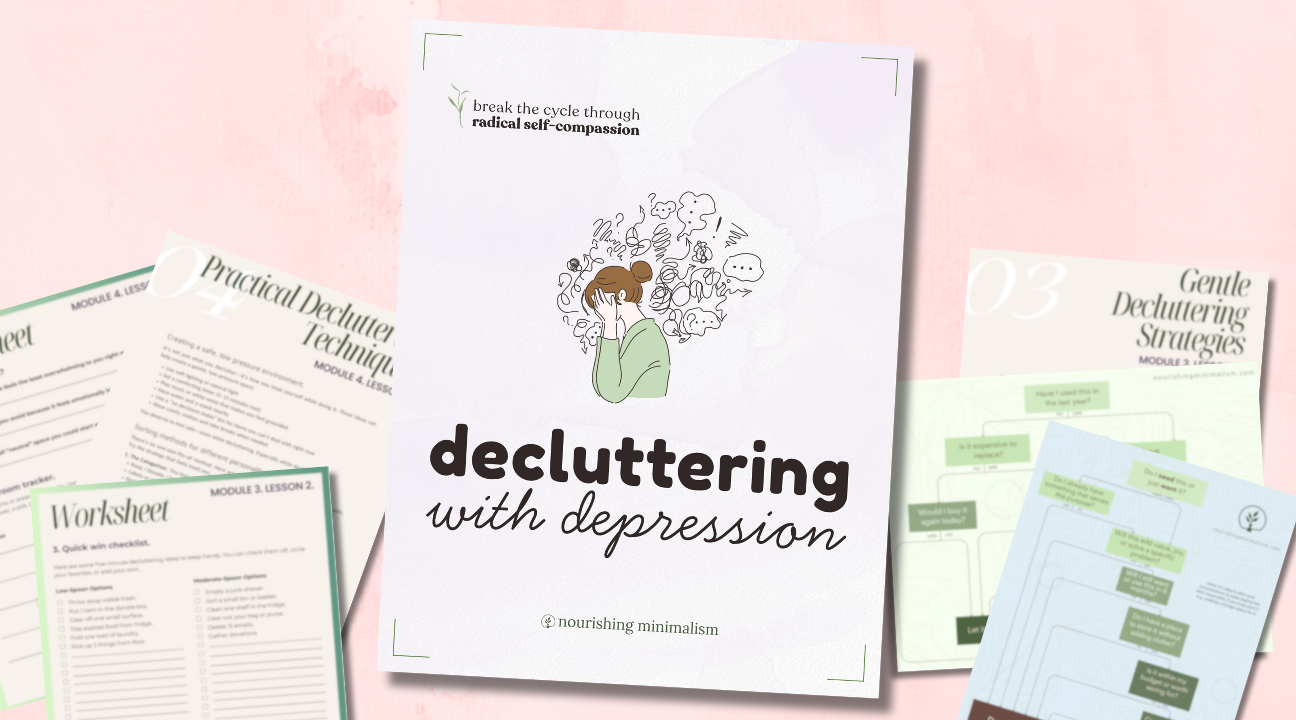
Decluttering with Depression is a self-paced guide built specifically for people who are grieving, burned out, or navigating mental illness.
No overwhelm. No unrealistic expectations. No 30-day sprints. Just compassionate, bite-sized steps that meet you where you are.
This 6-module guide gives you:
💧 Emotional permission to let go without shame
✏️ Journal prompts to help you unstick stuck feelings
🖊️ Helpful worksheets with each lesson to make it applicable
📍 Situationally appropriate and actionable baby steps
🤔 Decision-making flowcharts
🦻 Visual and audio versions of each lesson for accessibility
💬 Validation and support
