Here’s a little story–my good friend, let’s call him Danny, signed up for my New Year Declutter Challenge. Since Danny lives across the street, I peeked in on his progress after the first day. The first assignment was decluttering a kitchen counter.
I was surprised to find that Danny hadn’t decluttered a single thing! He rearranged things on the countertop and wiped it down, removing zero items from his house. It looked nice, but…
“How many things did you declutter?” I asked, failing to spot something missing.
“One,” he replied. “The countertop.”
“But what did you get rid of?”
“What do you mean?”
Then I realized that, despite having a bestie across the street who writes a decluttering blog (which he does read on occasion–hi, Danny! 👋☺️), the POINT of it had somehow been fully missed. He thought the one “item decluttered” was the surface he’d straightened up.
The next day, I came over to walk him through the process. We worked on the little entertainment center in his living room for fifteen minutes, tops. We decluttered SIXTY-EIGHT ITEMS from just that small space.
That’s the difference you can make just by understanding decluttering, conceptually.
Inspired by Danny, today I’m going to break down the absolute basics of decluttering so that he–and anyone else who’s missing the point–knows for sure what’s going on with the whole dEcLuTteRiNg thing.

What is decluttering?
Decluttering means getting things out of your house. It’s not cleaning, tidying, or organizing–that process comes after.
Decluttering is the act of removing items from your home, either by throwing them out, donating them, or using them up. By the end of it, you’ll simply own fewer items, making your life easier and your home a delight to manage.
Why should you declutter?
A cluttered living environment is shown to have many negative effects on our mental, physical, and emotional health. It hurts your sleep, which hurts everything–read about what sleeping in a cluttered environment did to my health in just a couple of weeks.
A clutter-free home takes less effort. Cleaning and maintaining a decluttered home is miles easier than trying to manage a cluttered space. Not only in the physical aspect, but also mentally and emotionally. We keep a running mental tally of everything in our home–whether we realize it or not.
And if you’re a woman, you’re likely even MORE susceptible to clutter-related stress. Yes, this is a scientifically supported thing. Clutter can even cause depression, especially in women, studies find.
Read more: The Clutter-Depression-Anxiety Cycle ⛈️
How do I start decluttering?
After you understand what decluttering is and why you should do it, it’s time to learn HOW to do it.
I’ll say this: Decluttering is a skill. That means it can be learned, practiced, and improved upon. If you’ve tried decluttering before and found you’re “bad” at it, never fear! You can always get better! It’s just about consistent effort and starting simple.
If you start with the easier categories, you get better at it, then you can work your way up to more difficult things. For example, I often recommend newbies to start with a trash sweep, where they simply fill a trash bag with obvious garbage from anywhere in their house. It’s low stakes, low mental effort, and can feel really encouraging while making a noticeable difference in your home.
From there, we might move to utility items, like duplicate kitchen tools with low sentimentality and low stakes.
The last categories to tackle are usually hobby supplies and sentimental items, as folks tend to struggle the most in these areas.
Want a confidence boost? We’ve got a checklist for 100 easy items to declutter. Get a head start without giving it a thought!

Decluttering strategies.
There are many schools of thought on how to best declutter a space. Here are two basic strategies to choose from.
1. Deep Decluttering (for go-getters who are ready to get it DONE)
By location. You might choose one location, like a kitchen cabinet, fully empty it, replace only what you’re keeping, and ditch the rest. This is a really satisfying way to declutter, because you get an ENITRE area of pristine peace to rest your eyes on.
The drawback is that it’s not technically the most efficient and effective way to declutter, because you’re only considering the items that are in that space, so you may accidentally keep duplicates and unnecessary items since you’re not considering where you might have similar things stored throughout the house.
That brings us to decluttering:
By category. This is when you gather everything in a category into one place to consider them all at once. This is my preferred method, but it might be more suited for your second or third round of decluttering, since it’s more specific–when you’re first getting started, it’s often best to just get stuff out however you can, and most people prefer going by location when the house is overwhelming.
You simply select your category, let’s say cooking utensils, and dig them out from everywhere–the drawers, the hooks, the grill on the patio, the jars, the camping supplies box–and put them in one place to evaluate them all together. This allows you to easily spot duplicates and really consider what you’ve got to make more informed decluttering decisions.
For decluttering by location OR category, you’ll need a:
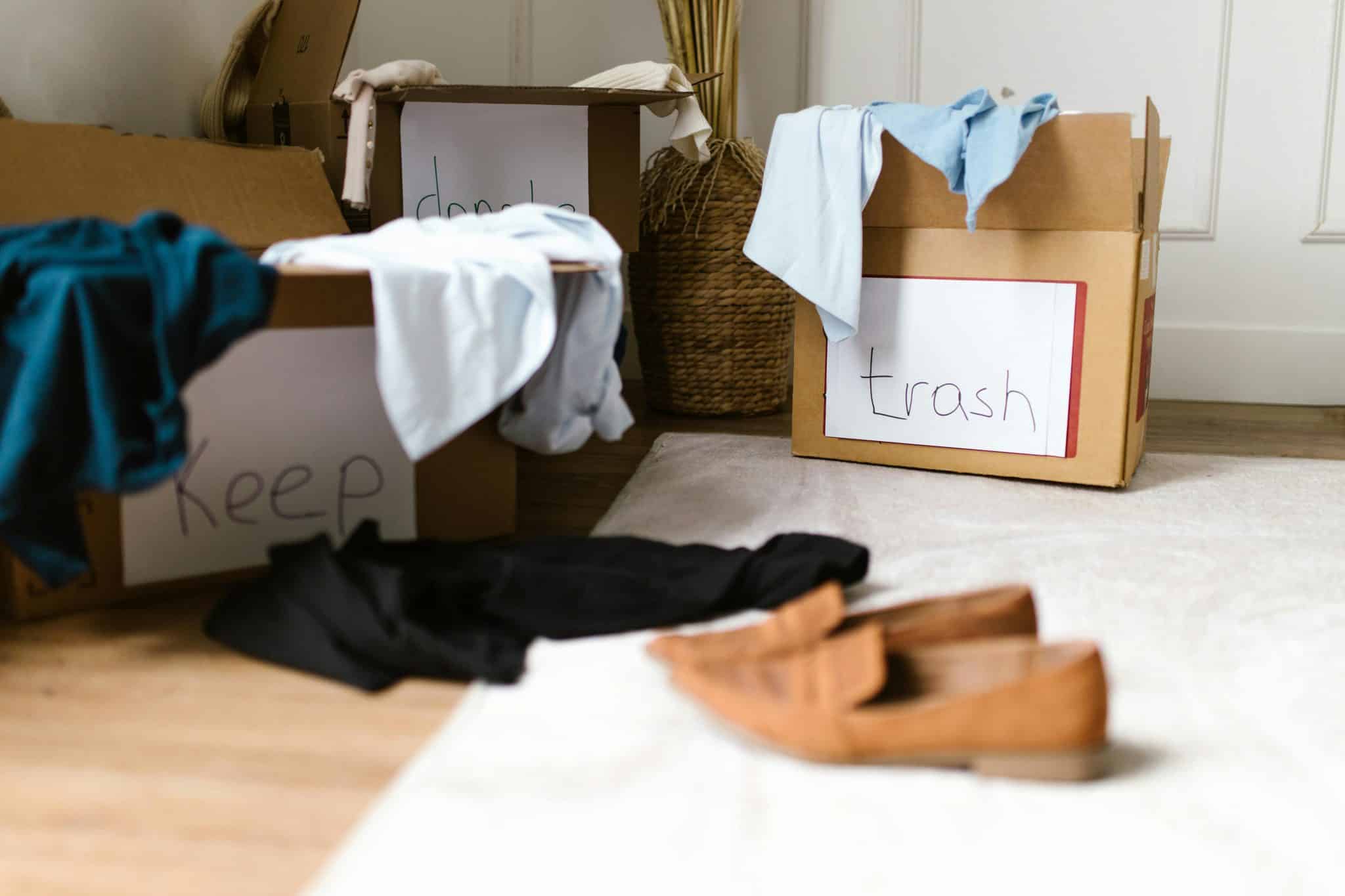
Sorting strategy. Often referred to as the Three Box Method, though it doesn’t need to be three, nor does it need to be boxes. Basically you want to establish your categories before you begin sorting–it makes decisions MUCH easier and everything will be faster.
Common sorting categories include:
- Trash (I like to use a trash bag, for obvious reasons)
- Donate (One container will do, but sometimes it gets more complicated*)
- Action (these are for items that need something done to them, like items to return)
- Keep (I prefer to fully empty the area, then replace whatever I’m keeping back into the cabinet/drawer–but sometimes a pile or box is tidier)
- Other Room (for items that you want to keep, but that live somewhere else–designating a container for these items can help keep you on task and not running around the house)
* I usually have multiple donation piles, because I’ll donate to the animal shelter, transitional housing, the secondhand craft store, etc. The more specifically you can donate, the less waste will accrue. For example, if I brought old pillows and towels to Goodwill, they’d toss them right in a landfill. But if I bring them to an animal shelter, they get a second life keeping doggies comfortable on the cold concrete. If I bring half-empty containers of fabric paint to a general thrift store, they’ll get thrown out–if I bring them to the crafting thrift store, they’ll get used!
HOWEVER–if you’re in a deep pit of clutter, don’t overcomplicate things. For some clients, I recommend not having a donation pile AT ALL. Just straight to the dumpster. Clutter can truly be a health crisis, so if you feel like you’re drowning, please take the easiest route. You can worry about reducing waste once you can actually breathe.
2. The Dana K. White Method (for people low on energy, time, or motivation)
If you’ve tried decluttering only to become too overwhelmed an hour in to continue, the Dana K White Method is PERFECT. This strategy avoids the chaos entirely and GUARANTEES success–that success is just marginal. Slow and steady wins the race here.
This is how it goes:
- Grab an item. Any item that’s lying around without a designated home. Grab something in front of you now.
- Ask yourself: If I needed this, where’s the first place I’d look for it? Put it there. If there’s not room, declutter that area until there is. For example, if I found a rogue pair of nail clippers in the living room, I’d think that the first place I would look for them is the bathroom drawer. If I go to place them there and the drawer is full, I can toss an empty container of face cream to make room.
- If you don’t know where you’d look for it, or if you can’t imagine a time where you WOULD look for it, there’s a good chance it doesn’t belong in your house. Declutter it!
- You’re done! Or…grab another item and do it again!
This method tosses the idea of sorting out the window. You’re guaranteed to make progress, because you’re only doing one item at a time. No piles, no emptying cabinets onto the floor, just consistent progress that takes mere seconds to do, anytime you wanna do it. This method requires it to be a HABIT for you to make genuine change in your home.
You can also double up with these methods by having “big decluttering” sessions, and using the Dana K White method whenever the urge strikes.
BONUS: 3. Passive Decluttering Strategies (for people who CANNOT be bothered)
The Dana K. White Method is quite low effort and low commitment, but we can get even LOWER effort here.
Upside down/backwards method. Instead of sorting through items, simply reorient them. For your closet, hang your clothes backwards. For your kitchen, put all the dishes upside down. As you use items, wash and replace them in the correct orientation. By the end of a designated period (a month is usually a good amount of time), you’ll know exactly what you used and what you didn’t, so you can feel good running through and donating everything that’s still upside down or backwards.
The basket method. This is good for areas like an office or bathroom, where we often have a ton of products that we don’t necessarily use, but don’t want to get rid of because they feel functional. Put all of the items in this area in a basket or box. As you use them, replace them back where they go. At the end of a designated period, you’ll know exactly what you’ve used. You can bring whatever’s left in the box directly to your donation center without a second thought!
Strategies like these make decluttering straightforward and effortless! Check out our full list of 10 passive decluttering strategies for folks who hate sorting piles.
How long does it take to declutter a house?
In my experience, decluttering happens in layers. You’ll do your first round on shaky legs, second-guessing yourself, doubting your decisions, worrying that you’ve gotten rid of something important you’ll need later.
But you’ll power through! You’ll get rid of a few things. Maybe they’re mostly easy decisions–trash, broken items, extra charging cords for obsolete technology you haven’t used in 40 years. But your house feels a little lighter. A little easier to navigate.
Then you’ll sit with that feeling of less. You’ll appreciate how having less to worry about improves your home’s daily functions, your sleep, your mood, your relationship with others in your home. Then you might go in for round two.
In your second attempt, you’ll get rid of even MORE. The single-use kitchen tools you haven’t touched in years. The extra blades to your food processor you’ve never even tried. Unopened bottles of lotion you bought with a coupon and hate the smell of.
With every round of decluttering, you reveal more of the picture of what your home COULD be. You get a little bit closer. You get better at decluttering. The decisions feel easier, and they happen faster. You can feel yourself building momentum. You might even start to enjoy the process!
I declutter my home as a regular part of my upkeep routine. When I run decluttering challenges, I’m in there with y’all! Maybe I’ll only declutter one or two things for each assignment, but it’s a forever process that makes me and my house feel better, so I keep coming back to reassess everything that I allow to take up space here. It’s a sort of ongoing curation.
And it gets easier and easier every time, because we have fewer things to deal with, AND because we have strengthened the skill of decluttering. We’ve built up our confidence in decision-making, we’ve realized we CAN do without or make do with an alternative.
For a detailed breakdown of how long you can expect decluttering your house to take, I’ve laid it all out here: How Long Does It Take to Declutter a House? Realistic Timeline + CALCULATOR
The heart of it? Decluttering is more of a lifestyle choice than a weekend activity. It’s not a one-and-doner. It’s a make-your-life-better-every-time-you-do-it type situation. And you can do it as many times as you’d like.
The most important thing to do is get started. And this 100-item checklist can hold your hand through it:
Those are the basics you need to know to get started. Happy decluttering!